
A storage water heater is simple to plumb: cold water goes in at the bottom, and hot water leaves at the top or, via an internal pipe, at the bottom too. But one part of the layout is there for safety — the safety valve — and it is the part people most often get wrong.
What the diagram shows
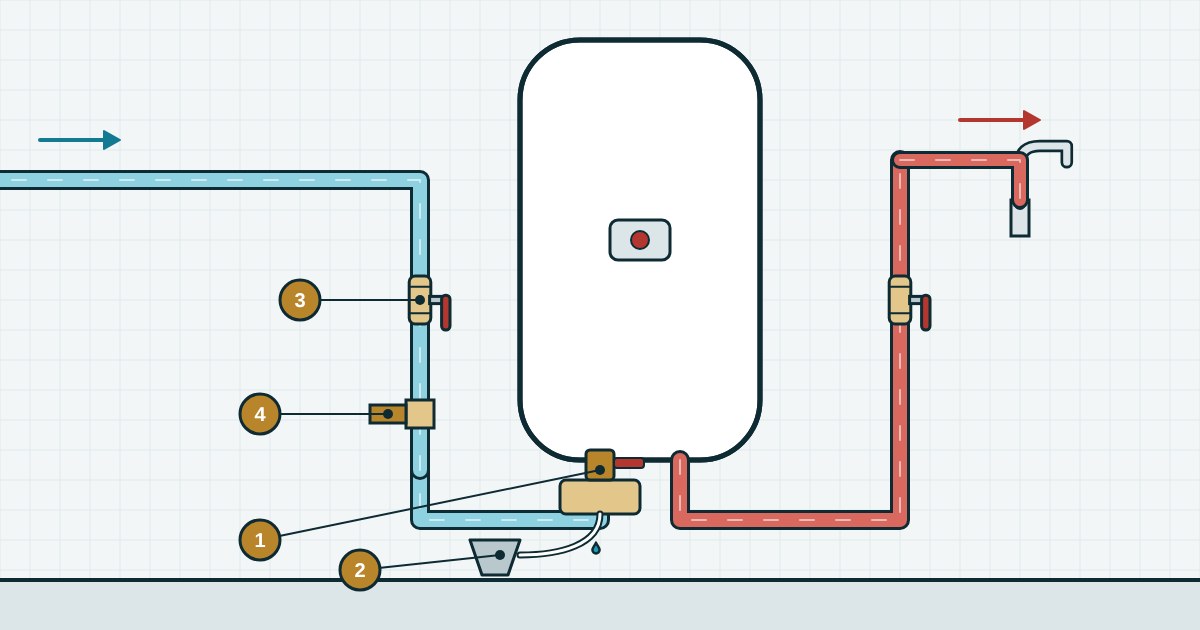
1 — the safety valve on the cold inlet, 2 — the valve’s discharge pipe into the drain via a funnel, 3 — isolation valves on the cold and hot pipes, 4 — a tee with a drain cock for emptying the tank.
The correct layout
- Cold water (the connection is usually marked blue) runs through an isolation valve, a drain tee and the safety valve straight into the heater.
- The safety valve is fitted directly on the heater inlet, with its arrow pointing towards the tank. There must be no valve or separate check valve between it and the heater — otherwise the pressure from heating has nowhere to go.
- Hot water (the connection marked red) leaves through an isolation valve to the taps.
- The drain tee goes before the safety valve. It makes draining easy when you descale the heater or shut it down for winter.
Many makers recommend dielectric unions on both connections — they reduce galvanic corrosion of the tank. Check the requirements in your model’s manual.
Why the valve drips and what to do
Water expands as it heats, and the valve releases the excess, so drips during heating are normal. That is why the valve discharge is piped to the drain through a funnel or a trap with an air break. If the valve runs constantly, the mains pressure is above the valve’s setting (usually 6–8 bar). In that case, fit a pressure reducing valve at the inlet or an expansion vessel for the hot water system.
First start-up
- Open the hot tap on a mixer, then open the cold supply valve to the heater.
- Wait until a steady stream with no air comes out of the mixer — the tank is full.
- Check every joint, and only then switch on the heating.
How to protect the heater from scale is explained in “Scale in a water heater”. Valves are in valves and fittings, and vessels for hot water are in expansion vessels.