
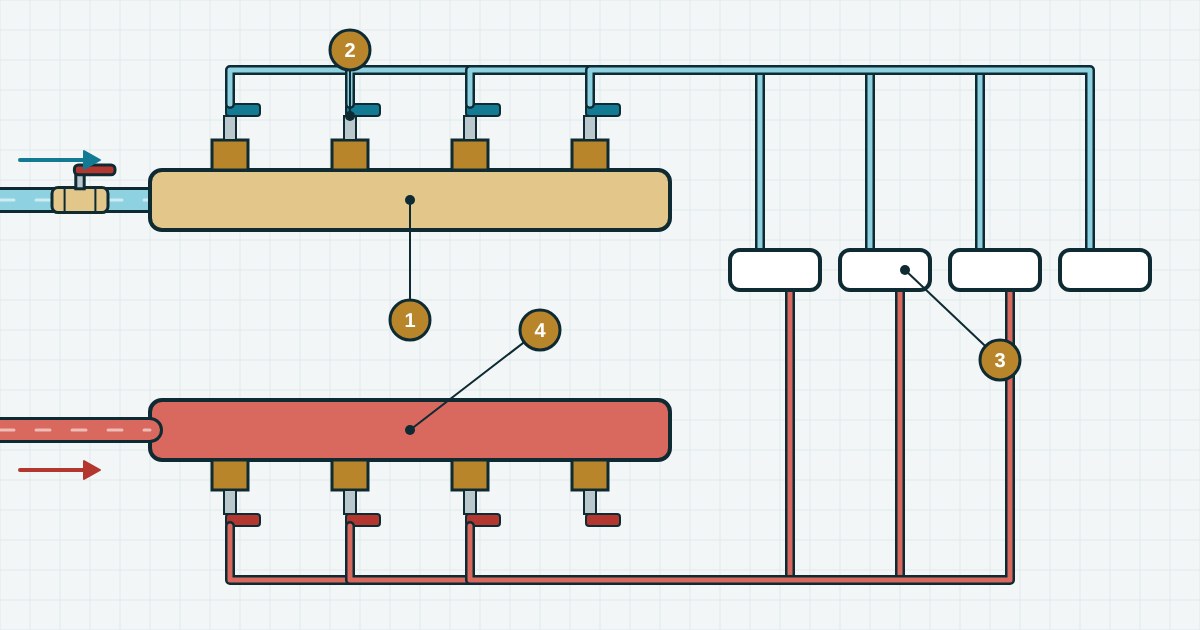
There are two ways to run water around a home. In a tee-branch layout, one pipe passes all the fixtures and each one tees off it. In a manifold layout, every fixture has its own pipe from a shared header — the manifold. A manifold needs more pipe, but it gives steady pressure and lets you isolate any fixture without shutting off the whole house.
What the diagram shows
1 — the cold water manifold, 2 — a valve on each manifold outlet, 3 — a fixture with its own dedicated pipe, 4 — the hot water manifold.
Pros and cons
- Steady pressure. When someone starts the washing machine, the shower does not go colder or weaker: each fixture draws from the manifold rather than from a shared pipe after its neighbour.
- Easy repairs. To replace a mixer or trace a leak, you close one valve on the manifold.
- Fewer joints in the walls. The pipe from the manifold to a fixture runs in one piece.
- Cons: more pipe, more space for the manifold (usually hidden in a cupboard or recess), and a higher cost.
What it consists of
- The inlet assembly: a valve, a mesh filter and, where needed, a pressure reducing valve and a meter. See “Water pressure reducing valve”.
- The cold manifold, 3/4" or 1", with one outlet per fixture plus one or two spares.
- The hot manifold, fed from the water heater or boiler.
- Outlet valves — ball or stop valves, labelled with the fixture each one feeds.
- Pipes to the fixtures, usually 16–20 mm. How to size them is explained in “Choosing the pipe diameter”.
Step-by-step installation
- Draw a plan: where the manifold goes, where each fixture is and how the pipes will run. Count the outlets.
- Fix the manifolds to the wall or inside a cupboard so the valves stay accessible.
- Run each pipe to its fixture in one piece, with no joints inside the walls, ideally in a protective sleeve.
- Label the outlets and pressure-test the system: fill it, raise the pressure and leave it for several hours, checking the gauge and every joint. Only then close up the walls.
If the hot manifold has a recirculation loop, remember that the return runs from the farthest fixture back to the water heater — it is a separate pipe, not a manifold outlet.
Pipes, fittings and valves are in pipes and fittings and valves and fittings. How to weld polypropylene is explained in “Welding polypropylene pipe”.