
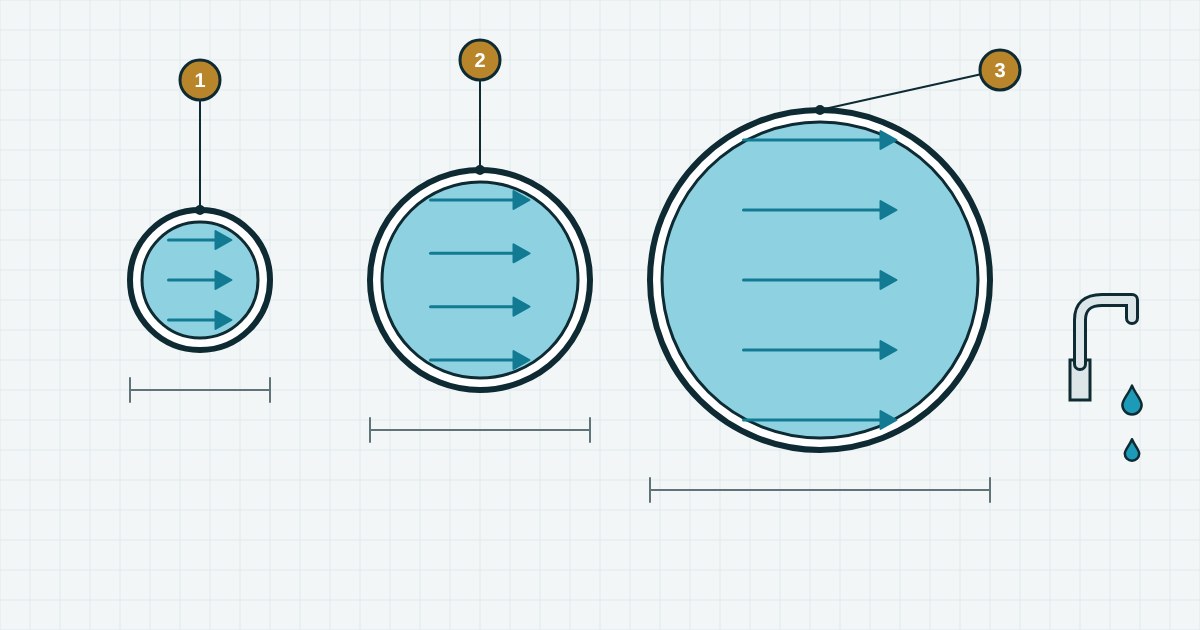
The pipe diameter decides whether the shower keeps its pressure when someone starts the dishwasher. A pipe that is too thin has high resistance and the water runs fast and noisily. One that is too thick costs more and takes longer to deliver hot water.
What the diagram shows
1 — a thin pipe for a single tap connection, 2 — a medium pipe for distribution in the house, 3 — a thick pipe for the supply and the main from the pump.
Outer and inner diameter
Plastic pipes are labelled by their outer diameter. A 20 mm polypropylene pipe is only about 13–15 mm inside, depending on the wall thickness. That is why 20 mm PP-R carries roughly as much water as a 1/2" steel pipe.
A simple table for a private house
| Section | Polypropylene | Multilayer | HDPE (outdoor) |
|---|---|---|---|
| Supply from the borehole or well | 32 mm | 32 mm | 32 mm |
| Main inside the house | 25–32 mm | 26 mm | — |
| Connection to one fixture | 20 mm | 16 mm | — |
In a large house with three or more bathrooms, make the main 32 mm and the supply 40 mm.
How to check yourself
- Water velocity in household pipes should not exceed 1.5–2 m/s. Faster flow brings noise and large pressure losses.
- A long thin pipe loses more pressure than a short one. On long branches go one size up.
- Never reduce the pump’s suction pipe: keep it the size of the pump inlet or larger.
If you are still not happy with the pressure, check the pressure switch settings and the size of the pressure tank.