
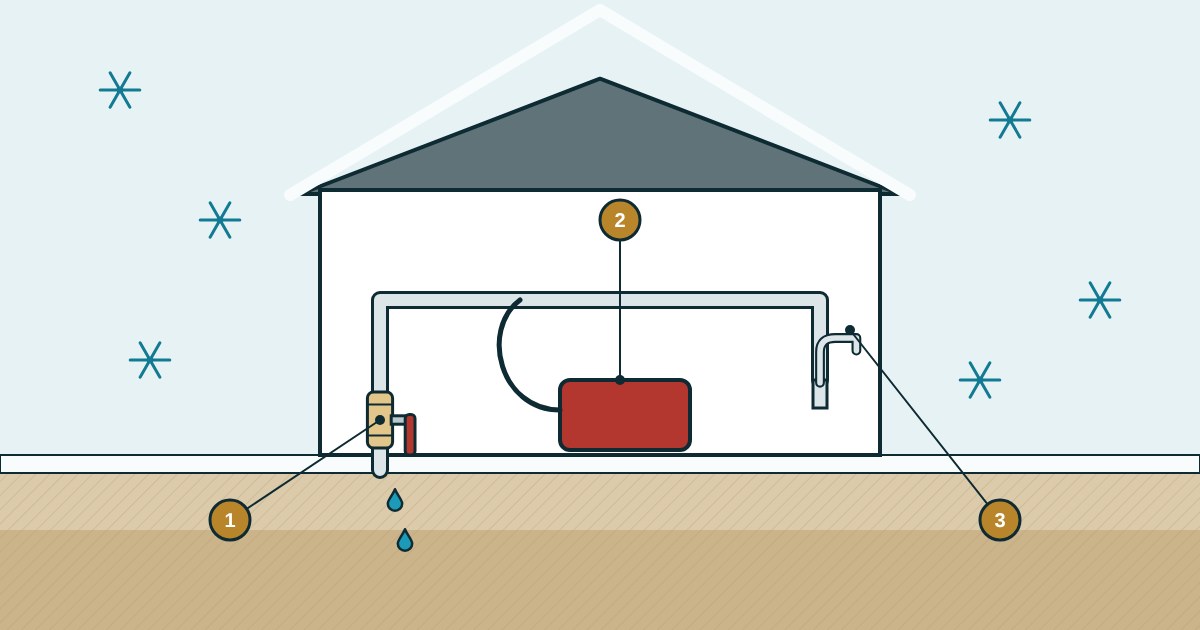
Water expands by about 9% when it freezes — enough to split a pipe, a pump casing or a water heater. If the house is not heated in winter, the system has to be drained completely. It takes a couple of hours and saves money and nerves in spring.
What the diagram shows
1 — the drain valve at the lowest point of the system, 2 — the compressor for blowing out the pipes, 3 — open taps and mixers.
Checklist
- Disconnect the pump from the power supply and shut off the water at the house inlet.
- Open every tap and mixer, including the shower, both hot and cold. Air gets in and the water drains freely.
- Drain the low points. If there are no drain valves, it is a good reason to fit them at the lowest points of the pipework.
- Blow out the pipes with a compressor through a drain valve or an air fitting, at no more than 2–3 bar. Do each branch until no more spray comes out of the tap.
- Booster set: remove the drain plug at the bottom of the pump casing and drain the suction pipe.
- Pressure tank — drain the water by disconnecting it from the pipe. There is no need to let the air out of the diaphragm.
- Water heater — close the inlet, open a hot tap and drain it through the safety valve or drain cock.
- Toilet — empty the cistern and soak up the rest with a sponge. Pour plumbing antifreeze into traps and the toilet so the water seals do not freeze.
- Filters — unscrew the housings, take out the cartridges and leave the housings empty.
Never use car antifreeze in plumbing — it is toxic. There are special propylene glycol based fluids for traps.
In spring
Close the drain valves, refit the plugs and put the cartridges back. Prime the pump with water and start it. Check the air in the pressure tank and go over the joints for drips.
Ball valves for drain points and new pressure tanks are in our catalogue.