
Two people can lower a pump into a borehole in half a day. The key is to prepare everything in advance and take your time: dropping a pump into a borehole is easy, getting it back out is very hard.
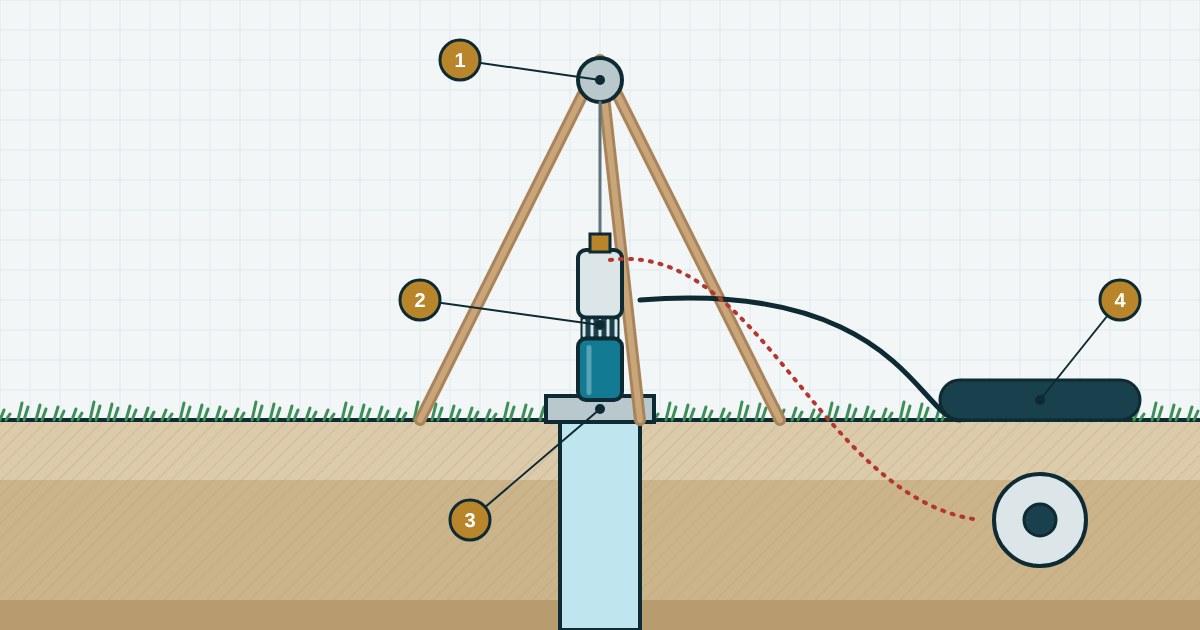
What the diagram shows
1 — the pulley on a tripod that carries the rope, 2 — the pump with its check valve, 3 — the well cap, 4 — the coil of pipe and the cable.
What to prepare
- The pump, a pressure tank and a pressure switch.
- 32 mm HDPE pipe rated for at least 10 bar — as long as the pump depth plus the run to the house.
- A stainless steel safety rope rated for at least five times the weight of the pump, the pipe and the water in it.
- Submersible cable, a heat-shrink splice kit, cable ties.
- A check valve (if the pump has none built in) and a well cap that fits the casing.
Step by step
- Uncoil the pipe in the sun — it will straighten and stop springing back.
- Screw the check valve and the pipe fitting onto the pump outlet. Seal the thread with tape.
- Join the pump lead to the submersible cable with the heat-shrink splice — it is the only joint that will be under water, so make it carefully.
- Tie the rope to the pump’s eyelets and secure the ends with clamps.
- Tie the pipe, cable and rope together every 1–1.5 m, leaving the cable a little slack.
- Lower the pump smoothly, without jerks, over the pulley or by hand, keeping the pipe from rubbing on the casing edge.
- Fix the rope to the well cap and bring the pipe out through its fitting. The cap keeps dirt and debris out of the borehole.
Never lower or lift the pump by the cable or the pipe — only by the rope.
Before the first start
If you can, check the cable insulation with an insulation tester. Connect the pump through the pressure switch and a circuit breaker. Let the water run outside for the first few minutes — sand and silt will come out first, then you can connect the house.
Choose the pump using our borehole pump guide, and the tank and switch in the pressure tanks and pump controls sections.