
A borehole pump is chosen by three numbers: how deep the water is, how much water the borehole gives and what pressure the house needs. All of them are in the borehole log provided by the drillers. If you have no log, you can measure the levels yourself with a weighted rope.
What the diagram shows
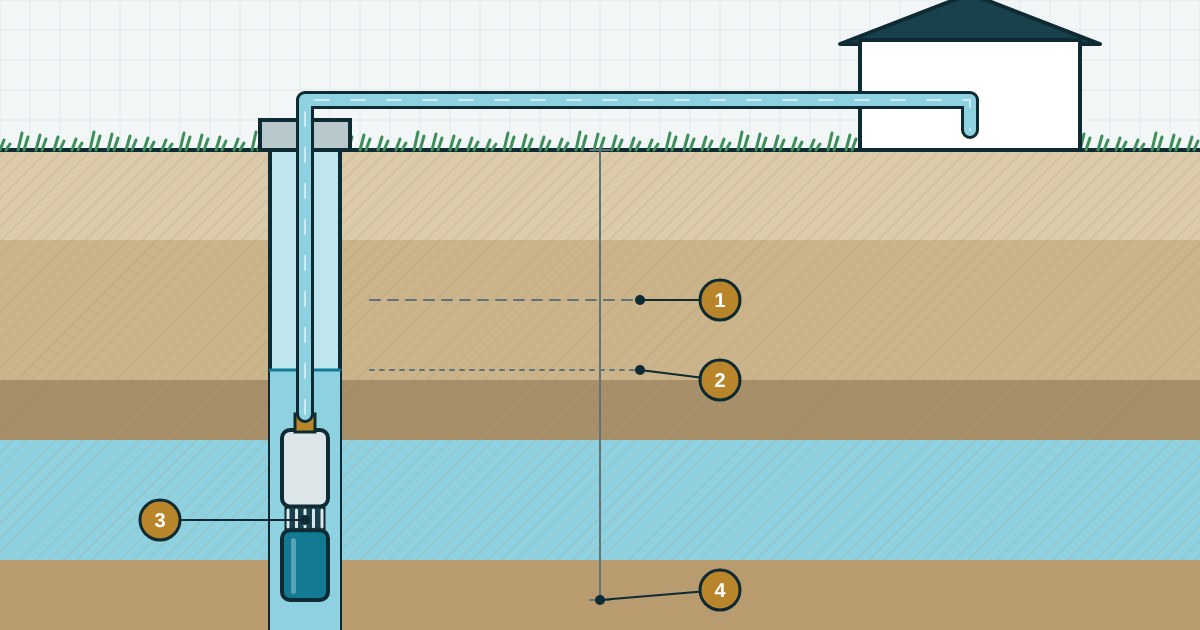
1 — the static level (water at rest), 2 — the dynamic level (water while the pump runs — it is lower), 3 — the pump, 4 — the total depth of the borehole.
Head: a worked example
Head is the height the pump can lift water to. Add up:
- the depth of the dynamic level — say, 30 m;
- the height of the highest tap in the house above ground — 5 m;
- pipe losses — about 1 m for every 10 m of horizontal pipe, 20 m to the house gives 2 m;
- the pressure you want at the tap — 2–3 bar, which is 20–30 m.
Total: 30 + 5 + 2 + 25 = 62 m. Look for a pump whose curve gives at least 62 m of head at the flow you need.
Flow rate and yield
A household uses about 2–2.5 m³/h when the kitchen, shower and toilet run at once. But the pump must not take more than the borehole gives (its yield). If the yield is 1.5 m³/h and the pump delivers 3 m³/h, it will drain the borehole and run dry. Choose a pump whose flow does not exceed the yield.
Diameter
Pumps come in 3" (about 75 mm) and 4" (about 98 mm) sizes. There must be a gap between the pump and the casing: a 4-inch pump needs an inner casing diameter of at least 100–105 mm, i.e. 110–125 mm plastic casing.
Where to hang the pump
1–2 m below the dynamic level and at least a metre above the bottom, where sand settles. Hang a pump without dry-run protection deeper or add a dry-run switch.
See our borehole pumps and matching pressure tanks.