
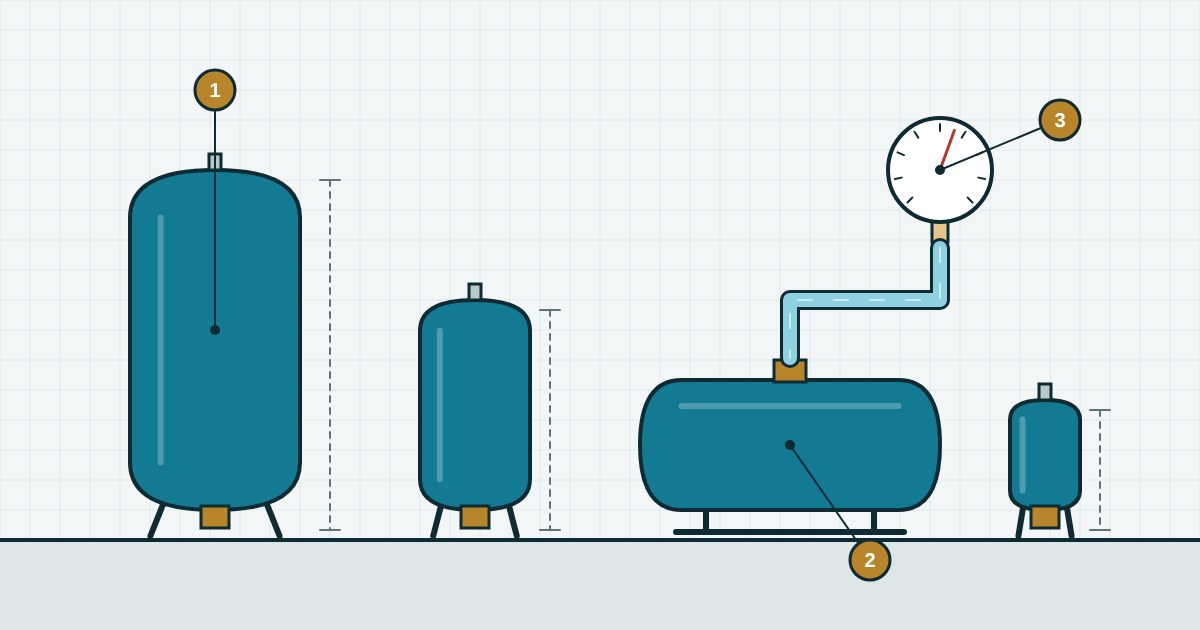
A pressure tank is a vessel with a rubber diaphragm that holds water under the pressure of compressed air. It keeps the pipes pressurised while the pump rests, smooths out pressure surges and saves the pump from unnecessary starts. It is easy to get it wrong: a tank that is too small makes the pump start every thirty seconds, one that is too large takes up half the boiler room and costs more than it needs to.
What the diagram shows
1 — a large vertical tank, 2 — a horizontal tank that can carry a surface pump on top, 3 — the pressure gauge used to set up the system.
Volume: start from the pump and the household
Only about a third of the tank volume is usable water; the rest is taken by air. At a 1.5–3 bar setting a 24 L tank delivers about 8 L of water and a 100 L tank about 35 L.
- Summer house, 1–2 people, booster set — 18–24 L.
- House for 3–4 people, borehole pump up to 1 kW — 50–80 L.
- Large house, several bathrooms, garden watering — 100–150 L or more.
A rule for the pump: the motor should not start more than 15–20 times per hour (check its manual). The more powerful the pump, the bigger the tank it needs.
Pressure
The tank’s maximum working pressure must be higher than the pump cut-out pressure. An 8–10 bar tank is enough for most homes. The factory air pre-charge is usually 1.5–2 bar, but it has to match the pressure switch: set the air 0.2–0.3 bar below the pump cut-in pressure.
Vertical or horizontal
A vertical tank takes less floor space and suits larger volumes. A horizontal one is more stable and can carry the pump on top, which is how compact booster sets are built. Both work the same way.
What else to check
- Replaceable diaphragm. A flanged tank can be repaired; a tank with a fixed diaphragm has to be replaced as a whole.
- Material. Coated steel, stainless steel or composite — the latter never rusts and suits damp rooms.
- Connection thread. 1" on tanks from 24 L, 3/4" on small ones.
You can pick a tank by volume and pressure in our pressure tanks section.