
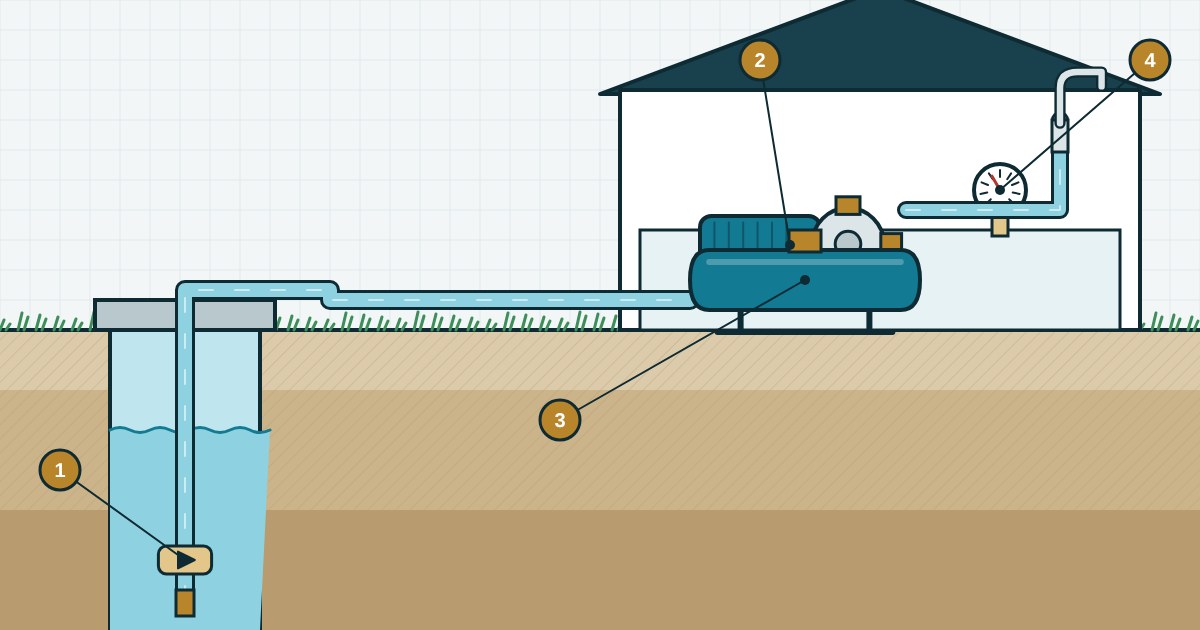
A booster set is a surface pump, a pressure tank and a pressure switch assembled together. It works when the water in the well or borehole is no deeper than 7–8 metres below the pump: a surface pump simply cannot lift water from deeper down — you need a submersible pump for that.
What the diagram shows
1 — the foot valve with a strainer at the end of the suction pipe, 2 — the pump, 3 — the pressure tank, 4 — the pressure gauge and the outlet to the house.
What you need
- A booster set with a suitable flow rate.
- 32 mm HDPE pipe (or at least the size of the pump inlet).
- A foot valve with a strainer, ball valves, fittings, PTFE tape or hemp with paste.
- A coarse filter after the pump.
Installation
- Place the set on a level base in a heated room, on a rubber mat to reduce vibration.
- Screw the foot valve onto the end of the suction pipe. Lower the pipe so the valve sits 30–50 cm below the lowest water level and 30 cm above the bottom.
- Run the pipe to the pump with a slight upward slope and no humps — air collects in them and the pump loses its prime.
- Fit a ball valve on the pump outlet, then the filter and the house pipework.
- Fill the pump casing and the suction pipe with water through the priming port.
- Switch the pump on and open a tap in the house slightly: when water runs without air, close it and wait for the pressure switch to stop the pump.
Never run the pump dry for more than a few seconds — the shaft seal will burn out. If no water comes after a minute, switch off and add more water.
Typical mistakes
- A thin suction pipe (20 mm instead of 32 mm, for example) — the pump is noisy and cannot hold pressure.
- Air leaking in through a thread — the set loses its prime overnight. Seal suction threads especially carefully.
- A booster set in an unheated shed — the casing will crack in winter.
Pressure switches, gauges and other parts are in the pump controls section, tanks are among the pressure tanks.