
Polypropylene is the most accessible material for DIY plumbing. The welding tool is cheap, and you can learn to make reliable joints in an evening on offcuts. The key is to keep to the heating times and never twist the parts while joining them.
What the diagram shows
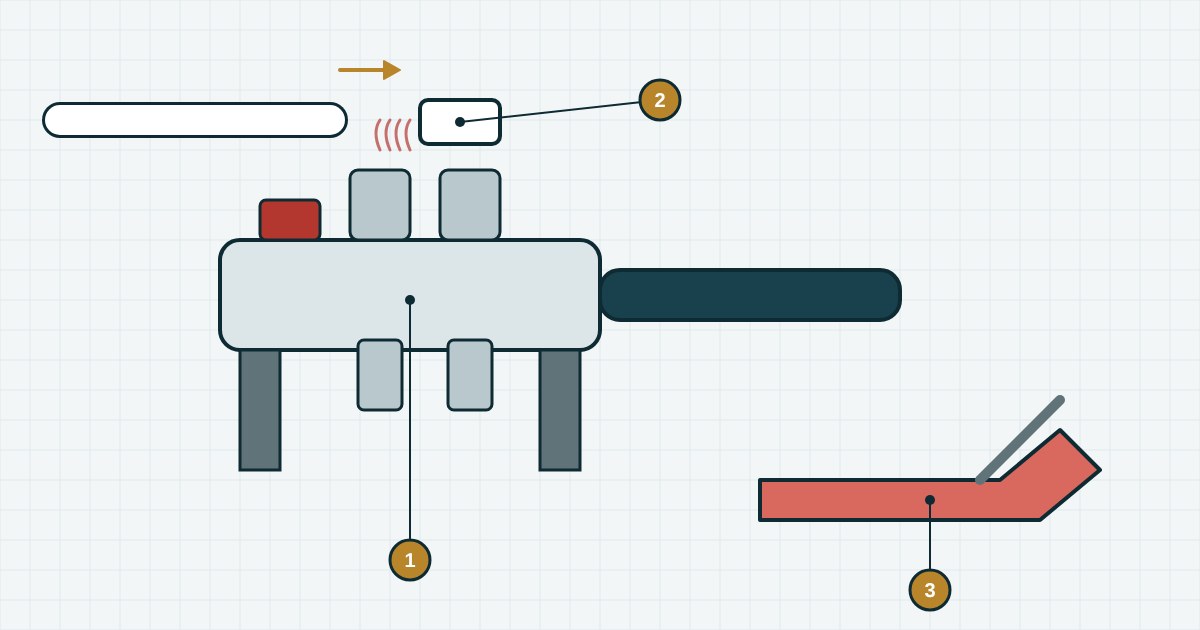
1 — the welding tool with heating sockets, 2 — a pipe and a fitting on the sockets, 3 — a cutter for a square cut.
Tools and preparation
- A welding tool with sockets of the right sizes, heating to 260 °C.
- A pipe cutter — the cut must be square to the pipe.
- A stripping tool (shaver) for aluminium-reinforced pipe.
- A marker and alcohol for degreasing.
Heating times
| Pipe size | Heating, s | Joining, s | Cooling, min |
|---|---|---|---|
| 20 mm | 5–6 | 4 | 2 |
| 25 mm | 7 | 4 | 2 |
| 32 mm | 8 | 6 | 4 |
| 40 mm | 12 | 6 | 4 |
These are guidelines; check the exact times with your pipe manufacturer. In a cold room add a few seconds to the heating time.
Step by step
- Cut the pipe and remove burrs. If it is aluminium-reinforced, strip the foil to the welding depth with the shaver. Fibreglass-reinforced pipe needs no stripping.
- Mark the insertion depth on the pipe with a marker.
- Push the pipe and the fitting onto the sockets at the same time, up to the mark, without twisting.
- Hold for the heating time, pull the parts off and join them at once, straight, up to the mark.
- You can correct the position for a few seconds, but without rotating. After that do not touch the joint until it has cooled.
Overheating is as bad as underheating: a bead forms inside the fitting and narrows the bore. If you see a thick bead on the inside, it is better to remake the joint.
Common mistakes
- The tool has not warmed up — switch it on 10–15 minutes before you start.
- Moisture on the pipe — the joint comes out porous and leaks.
- Unreinforced pipe on hot water — it bends a lot with temperature.
To connect pumps and tanks to polypropylene you will need threaded adapters and accessories.