
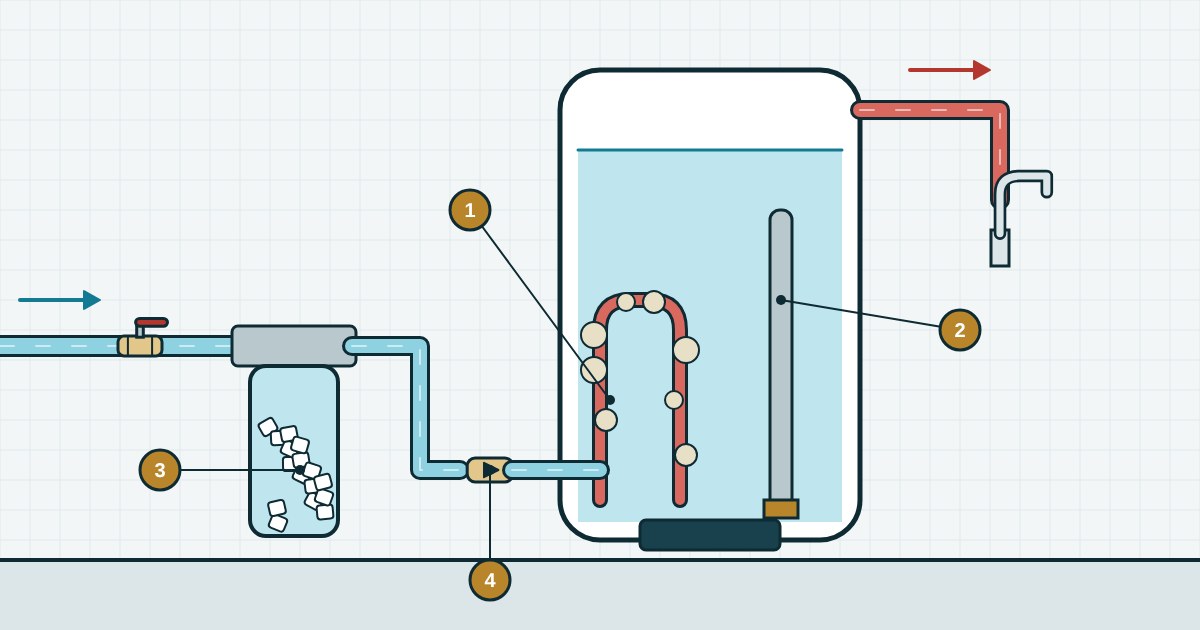
Hardness salts stay dissolved while the water is cold. When it heats up they drop out and settle where it is hottest — on the heating element. The scale acts like a fur coat: the element overheats, the water takes longer to heat, the electricity bill goes up and eventually the element burns out.
What the diagram shows
1 — a heating element coated with scale, 2 — the magnesium anode, 3 — a polyphosphate dosing filter on the cold supply, 4 — a check valve (usually part of the heater’s safety valve).
Signs of heavy scale
- The water takes noticeably longer to heat, and the heater runs almost non-stop.
- You hear hissing and crackling inside — water boiling under the scale layer.
- White flakes come out of the hot tap.
- White deposits quickly build up on taps and mixers — the water is hard, and the heater suffers just as much.
What protects the heater
- A polyphosphate dosing filter. A bowl of crystals fitted on the cold supply before the heater. The crystals slowly dissolve and stop hardness salts from settling as the water heats. The only consumable is the crystals themselves: top them up when the bowl empties.
- A magnetic filter. It fits into the pipe and needs no electricity. Its effect is weaker and depends a lot on the water, so with hard water do not rely on it alone.
- A 55–60 °C setting. Above 60 °C scale builds up several times faster. 55 °C is enough for showers and washing up.
- The magnesium anode. It does not remove scale, but it protects the tank from corrosion by corroding instead. Check it once a year and replace it when less than half of the rod is left.
It is safer to connect the kitchen drinking-water tap before the polyphosphate dosing filter: the dosing filter is there for appliances, not for drinking water.
How to descale a water heater yourself
- Switch the heater off, close the cold supply and open a hot tap to release the pressure.
- Drain the tank through the safety valve or a drain hose.
- Remove the flange with the element and the anode. Scoop the large lumps of scale out of the tank by hand.
- Soak the element in a citric acid solution (about 50 g per litre of warm water) for a few hours. Never scrape it with a knife — you will damage the sheath.
- Fit a new flange gasket, reassemble, fill the tank until water runs from the hot tap, and only then switch it on.
Never switch on an empty water heater: a dry element burns out in minutes.
If scale appears everywhere — on taps, in the kettle, in the washing machine — protecting the heater alone is not enough. Test your water and choose a system using “How to choose a water filter”. Dosing filters and boiler kits are in water softeners and scale protection.