
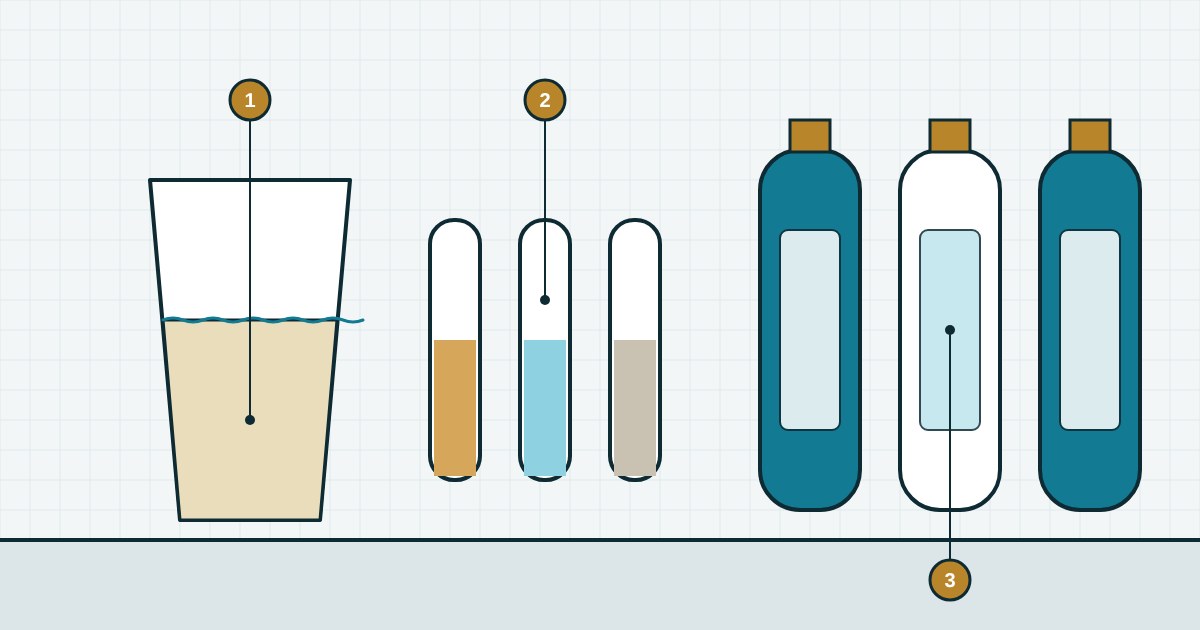
Borehole water can differ completely between neighbouring plots. That is why a filter is chosen from a laboratory test, not by eye. Any sanitary or private laboratory will test your water for a modest fee — it saves you from buying equipment you do not need.
What the diagram shows
1 — the water sample, 2 — the test results, 3 — treatment columns, each for its own task.
How to take a sample
- Let the water run for 10–15 minutes so it comes straight from the borehole.
- Fill a clean bottle to the brim, without air, and close it at once.
- Take it to the lab the same day.
What to look at
| Parameter | Drinking water limit | If higher |
|---|---|---|
| Total iron | up to 0.2 mg/L | iron removal filter |
| Manganese | up to 0.05 mg/L | iron filter with manganese media |
| Hardness | up to 7 meq/L | water softener |
| Nitrates | up to 50 mg/L | reverse osmosis or ion exchange media |
The limits are from the Ukrainian sanitary rules for drinking water (DSanPiN 2.2.4-171-10). Labs usually mark next to each value whether the limit is exceeded.
Order of stages
- Sediment — a 50–100 µm screen or cartridge filter right after the pump.
- Iron removal — if iron and manganese are present.
- Softening — if the water is hard. Without iron removal in front of it, iron quickly ruins the softener resin.
- Drinking water polishing — carbon or reverse osmosis in the kitchen.
If hardness only bothers you in the kettle and everything else is within limits, a kitchen reverse osmosis unit may be enough without a whole-house system.
Filters and cartridges are in our water filters section, membranes and tanks among the reverse osmosis systems.