
Low pressure can almost always be fixed without replacing pipes. The key is not to guess but to narrow it down: one tap or the whole house, hot water only or both, all the time or at certain hours. Answering these three questions rules out half the causes straight away.
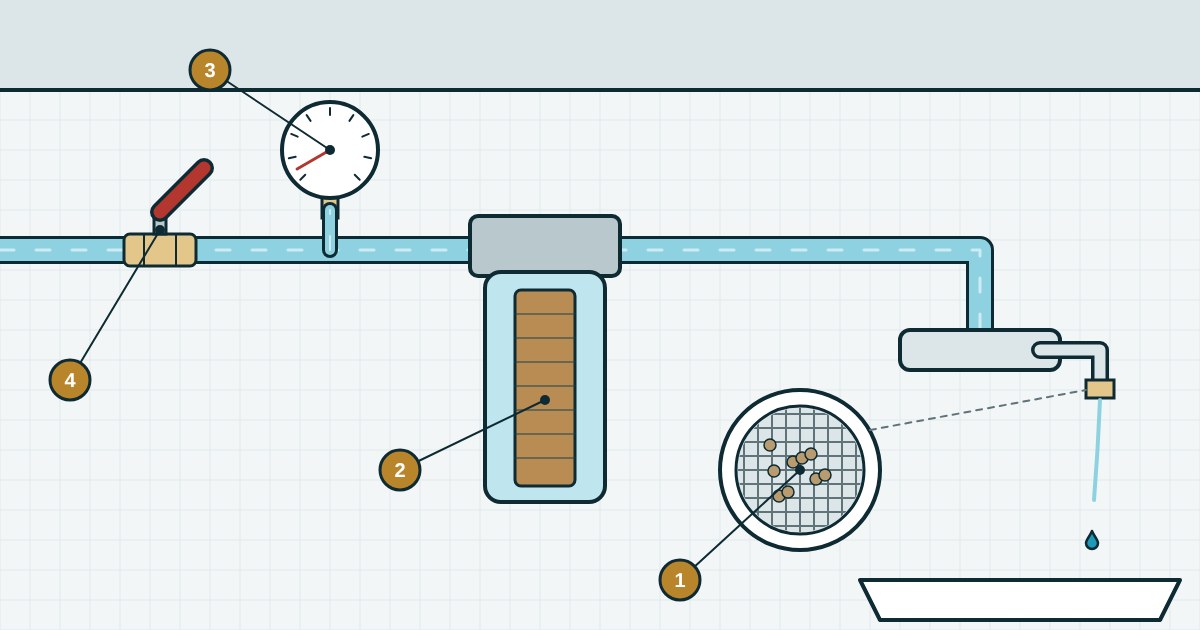
What the diagram shows
1 — a mixer aerator clogged with sand, 2 — a dirty filter cartridge, 3 — a pressure gauge showing the system pressure, 4 — a valve that is not fully open.
Step 1. One tap or the whole house
If only one tap runs weakly, the problem is in that tap:
- The aerator. Unscrew the small mesh at the spout by hand, or with a spanner over a cloth. Shake out the sand and rust, and dissolve deposits in vinegar or citric acid.
- The cartridge or valve head. Debris also gets stuck in the inlet holes of a mixer cartridge. Shut off the water, remove the cartridge and rinse it.
- The flexible hose. An old hose swells inside and narrows. Replace the whole hose.
Step 2. Weak everywhere — check the pressure
Look at the gauge after the pump or at the inlet. 2–4 bar is normal for a house. If the pressure is normal but the taps run weakly, water is losing pressure on the way. If it is low, the problem is the source.
Step 3. Normal pressure, but no flow
- Filters. The most common cause. A clogged cartridge or mesh can cut the outlet pressure almost to zero. Rinse the mesh and replace the cartridges — see “How to replace a filter cartridge”.
- Valves on the pipe. After repairs someone may have left a ball valve partly closed. The handle should be in line with the pipe.
- Narrow pipes. A long run of 16 mm pipe feeding several outlets will not give good flow however high the pressure. How to size pipes is explained in “Choosing the pipe diameter”.
- Old steel pipes rust up from the inside. Only replacing that section helps.
Step 4. Low pressure — check the pump and tank
- Pressure switch settings. If the pump cuts out at 2 bar, you will not get strong flow. How to raise the thresholds is explained in “Setting up a pressure switch”.
- Air in the pressure tank. With the wrong air charge the flow surges between strong and weak. Check it using “Checking the air charge”.
- The pump or the source itself. A worn pump or a borehole that runs short of water also gives weak flow. If the pressure sags during long use and then recovers, the source cannot keep up with that demand.
Replacement cartridges and meshes are in filter cartridges; pressure switches and gauges are in pump controls.