
Scale on the walls of a heat exchanger acts like a blanket: heat from the burner passes to the water less well, so the boiler burns more gas, overheats and gets noisy. On combi boilers the hot water flow weakens too. Descaling restores the boiler's output, and with a flushing pump you can do it yourself in a couple of hours.
What the diagram shows
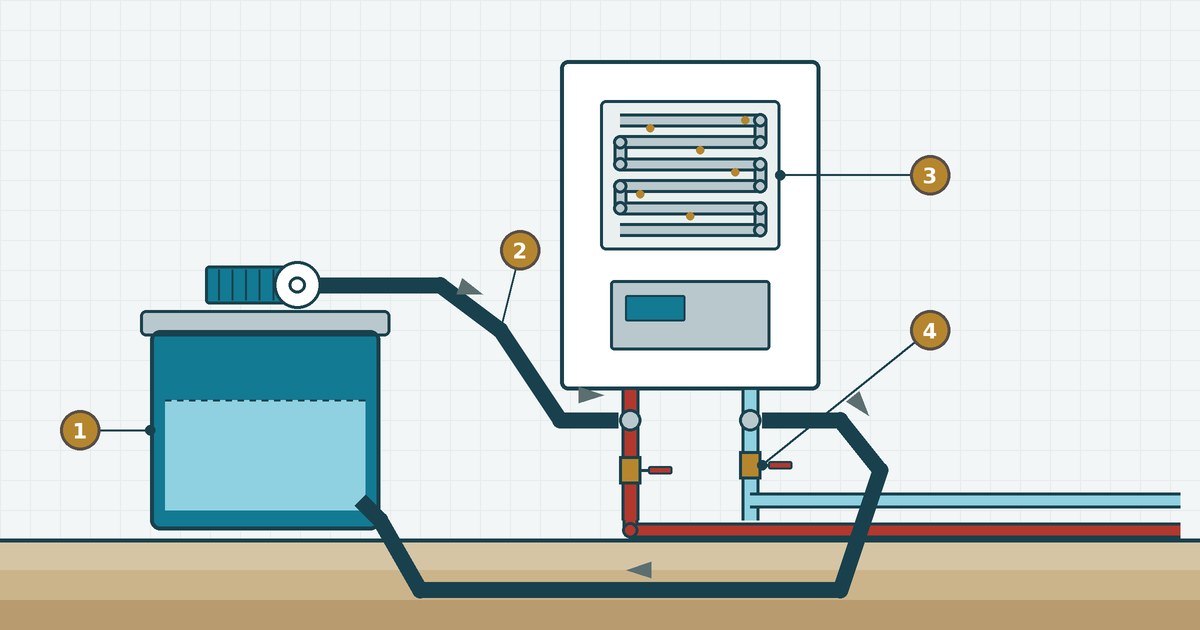
1 — a flushing pump with a tank for the solution, 2 — the flow and return hoses, 3 — the scaled-up boiler heat exchanger, 4 — the boiler valves closed off from the heating system.
When it is time to descale
- The boiler is noisy, whistles or “kettles” at normal temperatures.
- The boiler shows an overheat fault or keeps shutting down.
- On a combi boiler, hot water barely flows or does not heat up, while cold water runs fine.
- Gas consumption has gone up, but the house is no warmer.
What you need
- A flushing pump with a tank and a reverse function — it circulates the solution and periodically changes direction to loosen deposits from both sides.
- Two hoses with adapters for the boiler connections.
- A descaling solution suited to the heat exchanger material: acid-based products work for copper and stainless steel, while aluminium and silumin need special mild products — strong acid eats into them. Check the boiler manual.
- Gloves, goggles, a bucket and a neutraliser if the product manufacturer requires one.
Step by step
- Switch the boiler off, unplug it and let it cool down.
- Close the valves on the boiler flow and return so the solution does not get into the radiators. Drain the boiler through its drain cock.
- Connect the hoses: pump outlet to one boiler connection, return to the other. It is easiest if tees with flushing valves were fitted under the boiler during installation.
- Pour the solution into the tank and start the pump. Circulate it for as long as the product says (usually 30–90 minutes), switching the reverse from time to time. Foam and bubbles mean the scale is dissolving.
- Drain the solution and flush the heat exchanger with clean water until it runs clear, using a neutraliser if needed.
- Disconnect the hoses, open the boiler valves, top the system up to working pressure and bleed the air.
The secondary plate heat exchanger for hot water on a combi boiler is flushed the same way, either removed or through the hot water connections. To slow down scaling, fit a filter on the filling loop and the hot water inlet — see “Protecting a water heater from scale”. Flushing pumps are in heat exchanger flushing pumps.