
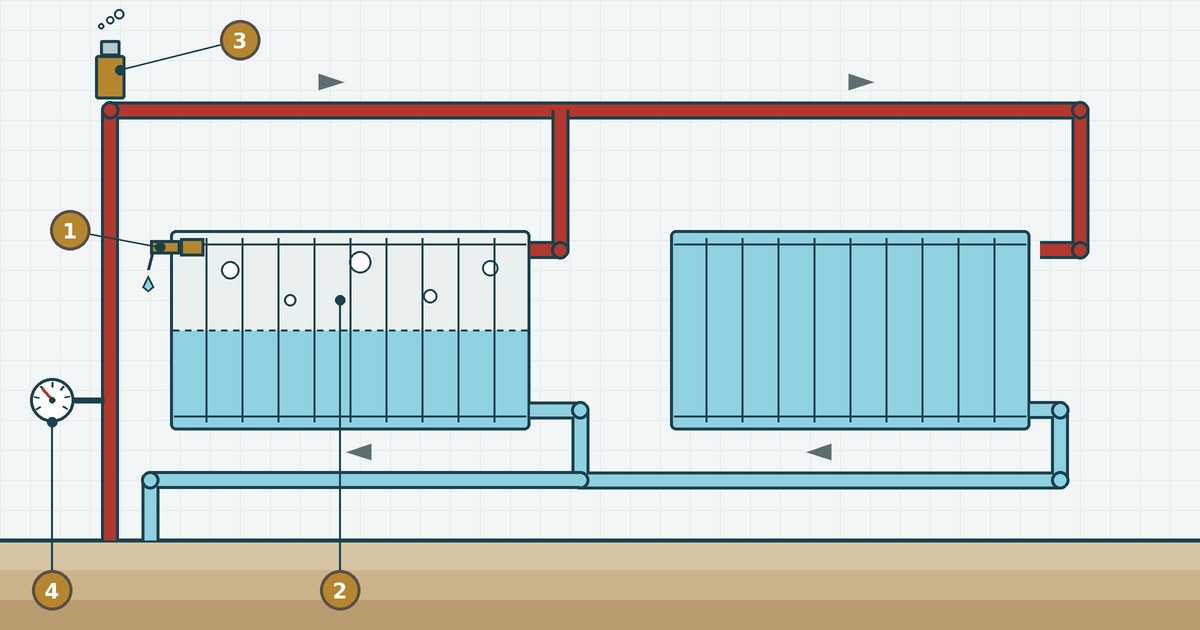
If a radiator is hot at the bottom and cold at the top, the pipes gurgle and trickle, and the circulation pump is noisy, there is air in the system. It collects at the highest points — the tops of the radiators and high spots in the pipework — blocks the water, and the heat never reaches the room. Bleeding it takes half an hour and needs no special skills.
What the diagram shows
1 — the radiator bleed valve, 2 — air trapped at the top of the radiator, 3 — an automatic air vent at the high point of the system, 4 — the pressure gauge.
How to bleed the air
- Switch off the circulation pump and wait 10–15 minutes: while the water is still, the air rises to the tops of the radiators.
- Have a radiator key or a flat screwdriver, a cloth and a small container ready.
- Start with the radiator closest to the boiler on the lowest floor, then work along the pipe run and up floor by floor.
- Turn the bleed screw anticlockwise half a turn. Air will hiss out first, then water with bubbles.
- As soon as a steady stream of water without bubbles appears, close the valve. Do not overtighten — finger-tight is enough.
- Go round all the radiators, then switch the pump back on and repeat after an hour or two on any that still heat poorly.
Check the pressure
Some water leaves the system along with the air, so the pressure drops. Look at the boiler gauge: a sealed system in a private house is usually kept at 1–1.5 bar when cold — check the boiler manual for the exact figure. If it is lower, top up through the filling loop. Low pressure is a common reason for air coming back.
Why the air comes back
- The system was recently filled. Fresh water contains dissolved air that comes out as it heats during the first weeks — this is normal, and you will need to bleed a few times.
- There is a leak somewhere. The system is constantly topped up with fresh water, which brings new air with it. Check the joints and the expansion vessel.
- No air vents at the high points. Fit an automatic air vent at the highest point of the pipework and on the manifolds. With an isolating valve underneath, it can be replaced without draining the system.
- The pipes have humps. Air gets trapped wherever a pipe rises and then drops again. These spots need air vents too.
Automatic air vents and safety groups are in safety groups and air vents, pressure gauges in gauges and thermometers. If the radiators still heat unevenly after bleeding, check the pump: how to choose a circulation pump.