
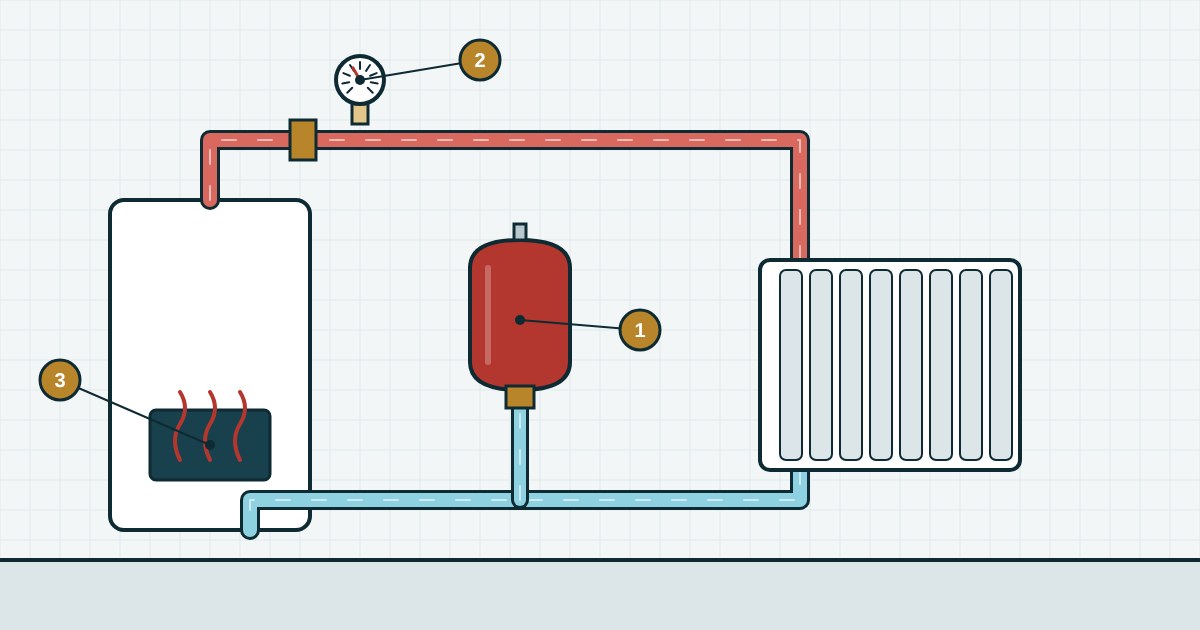
Water expands when heated: a 100 L system gains about 3 L of volume at 80 °C. If that extra volume has nowhere to go, the pressure rises and the boiler’s safety valve opens. An expansion vessel takes up the excess and gives it back when the system cools down.
What the diagram shows
1 — the expansion vessel (red, for heating), 2 — the safety group pressure gauge, 3 — the boiler.
Volume: a simple rule
Take 10–12% of the total water volume of the system. You can estimate the system volume at about 10–15 L of water per kilowatt of boiler output for radiator systems. A 24 kW boiler means roughly 300 L, so you need a 30–35 L vessel. Underfloor heating holds more water — allow a margin.
Air pre-charge
The air pre-charge should equal the pressure of the water column above the vessel plus 0.2–0.3 bar. A vessel in the basement of a two-storey house with a 7 m high system: 0.7 + 0.3 = 1.0 bar. Fill the cold system to 0.2–0.3 bar above the vessel pre-charge — about 1.2–1.5 bar.
Where to connect it
- On the return pipe before the circulation pump — the temperature is lower there and the diaphragm lasts longer.
- There must be no shut-off valve between the vessel and the system that could be closed by mistake. A lockable service valve or a quick-release coupling is the most convenient option.
- Mount the vessel on the wall or stand it on the floor, connection up or down as the manufacturer specifies.
Maintenance
Once a year, before the heating season, check the vessel’s air pre-charge with the system pressure released. If the air escapes quickly or water comes out of the valve, the diaphragm is damaged.
Vessels for heating and solar systems are in our expansion tanks section.