
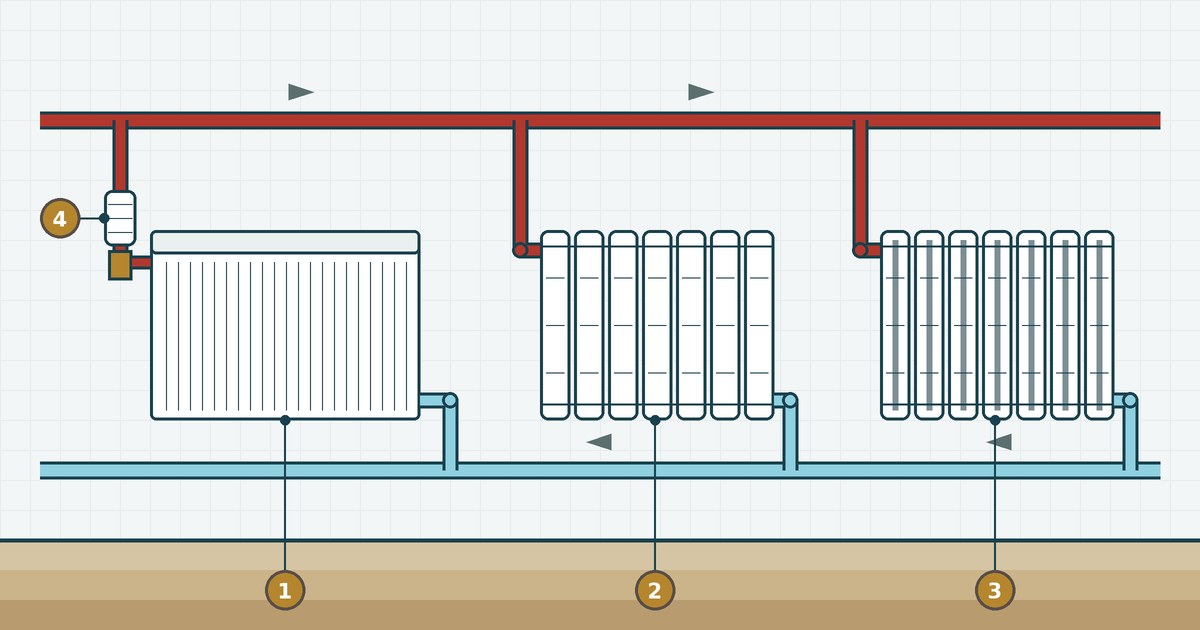
A radiator should be chosen by the heating system it will be connected to, not by price or looks. In an apartment block with district heating, radiators face water hammer and high pressure; in a private house with its own boiler they do not, but fast warm-up and gas savings matter. Here is which type belongs where.
What the diagram shows
1 — a steel panel radiator, 2 — an aluminium sectional radiator, 3 — a bimetal radiator (steel core inside), 4 — a thermostatic head on the flow valve.
Steel panel radiators
Two steel sheets welded with water channels, plus fins at the back. They hold little water, so they heat up fast and respond quickly to a thermostatic head — that is where the savings come from. Working pressure is usually up to 8–10 bar: plenty for a house or a flat with its own boiler, risky for district heating.
- Type 11 is a single panel, the slimmest; type 22 has two panels and two rows of fins and gives almost twice the heat at the same length; type 33 has three panels for large windows.
- 300 mm high models go under low windows, 500 mm is the standard.
- Do not leave a system with steel radiators drained for long: the steel inside starts to rust.
Aluminium radiators
The highest output per section, light, and sections can be added. Aluminium is sensitive to water quality: in acidic or alkaline water it corrodes and gives off gas, so each radiator needs an air vent. A good choice for a private house with a boiler and clean system water.
Bimetal radiators
Aluminium outside, steel or copper channels inside, so the water never touches aluminium. They withstand 20–25 bar and water hammer and do not mind dirty district heating water. This is the choice for a flat on district heating, though they cost more than the others.
Quick choice
- Flat on district heating — bimetal.
- Private house or flat with its own boiler — steel panel (best value) or aluminium.
- Fit every radiator with a thermostatic valve and head: rooms do not overheat and the boiler starts less often.
- Connection: side connection when pipes come from the side, bottom connection when they come out of the floor.
Steel radiators are in the type 22, type 11 and low 300 mm selections, thermostatic heads are here. The whole section is heating radiators. If a radiator is warm only at the top or bottom, read “Air in radiators”.