
A ball valve sits open for years, and when you finally need to close it the handle will not move — or it closes but water still flows. This is the typical fate of valves nobody has touched for a few years. Some of these problems take five minutes to fix, but there is a point where replacing the valve is the safer option.
What the diagram shows
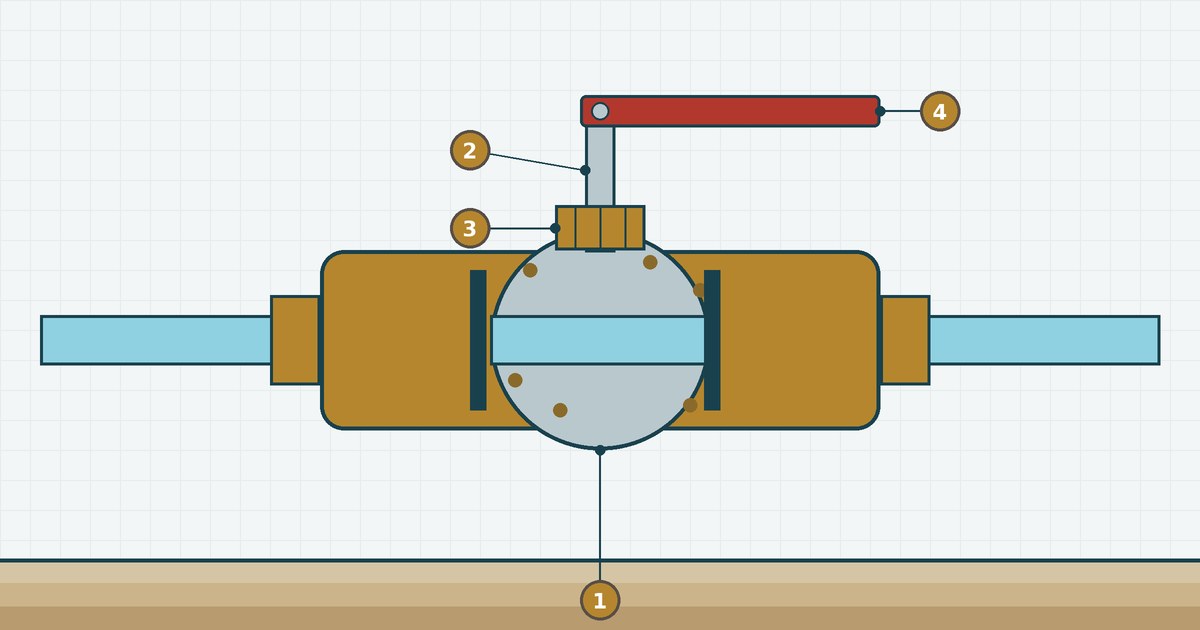
1 — the ball with scale on it, 2 — the stem, 3 — the gland nut, 4 — the handle.
Why it happens
The ball (1) stays in one position for years, and hardness salts and rust build up on the exposed part. When the valve is turned, the deposit presses against the seat seals. Force it, and the deposit scratches the seals — after which the valve no longer holds water.
The handle will not turn
- Do not use a pipe wrench with an extension: the brass stem (2) shears easily, and then the valve has to be replaced under pressure.
- Put a drop of penetrating oil on the stem under the handle and wait 10–15 minutes.
- Rock the handle back and forth in small movements, gradually widening the angle. The valve usually frees up within a few minutes.
- Close and open it fully several times — this wipes the deposit off the ball.
It leaks from under the handle
A leak along the stem means the gland. Many valves have a gland nut (3) under the handle: tighten it a quarter to half a turn until the leak stops. Do not overtighten or the handle will become stiff. If there is no nut or tightening does not help, replace the valve.
Closed, but water still flows
The seat seals or the ball itself are damaged. Such a valve usually cannot be repaired, only replaced. If it is the main inlet valve, first shut the water off upstream — at the riser, in the meter pit, or by switching off the pump.
How to replace a valve yourself — see “Replacing a ball valve”. New valves: 1/2", 3/4", 1" and valves with a union, which are easier to remove next time.