
A ball valve lasts a long time, but not forever: it starts weeping around the stem, stops shutting off the water or seizes so the handle will not turn. Repairing it rarely makes sense — replacing it is easier. The job takes 20–30 minutes.
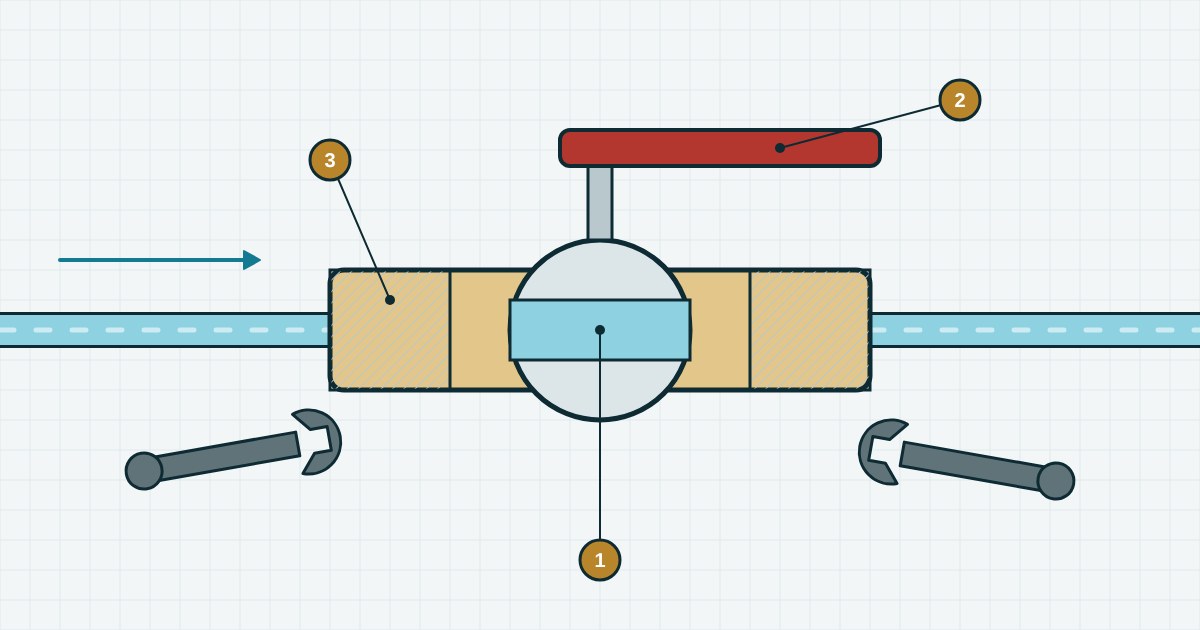
What the diagram shows
1 — the ball with a bore, which shuts off the water, 2 — the handle, 3 — the threaded ends of the valve.
Tools
- Two pipe wrenches or adjustable spanners.
- A new valve of the same size and thread type (female–female, male–female).
- Hemp with paste, PTFE tape or sealing cord. A rag and a bucket.
Step by step
- Shut off the water upstream — at the main inlet — or switch off the pump. Open a tap downstream to release the pressure and drain the water.
- Hold the pipe or the adjacent fitting firmly with one wrench and undo the valve with the other. Without the second wrench you can strip the pipe thread or twist the fitting inside the wall.
- Clean the old sealant off the pipe thread with a brush.
- Wind new sealant in the direction of the thread.
- Screw the new valve on by hand, then with a wrench while holding the pipe with the other. Position the handle so it is easy to use.
- Close the new valve, turn the water on slowly and check the joint. Then open the valve and check again.
If the valve is somewhere it will often need removing (before a meter, a filter or a pump), choose one with a union nut. Next time you will not have to unscrew the whole pipe.
Which valve to choose
- A brass body rather than a zinc alloy one — brass is heavier and does not break at the thread.
- A full-bore valve does not restrict the pipe — important on the supply and after the pump.
- A lever handle for frequent use, a butterfly handle for tight spots.
For pump and tank connections: valves, fittings and accessories.