
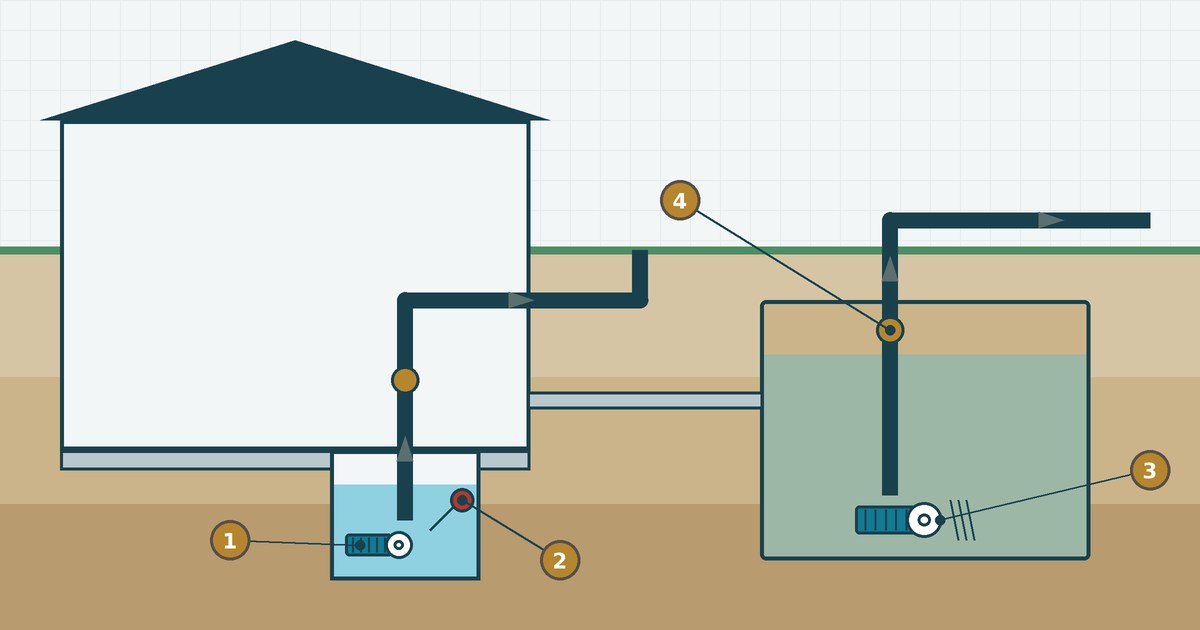
Submersible pumps for dirty water look alike but are built for different jobs. A drainage pump will empty a basement after a downpour but cannot handle sewage, while a sewage pump moves waste water but is overkill and expensive for clean water. The choice starts with one question: what exactly will be in the water.
What the diagram shows
1 — a drainage pump in a basement sump, 2 — the float that switches the pump on and off, 3 — a grinder sewage pump in a septic tank, 4 — a discharge pipe with a check valve.
Drainage pump
For water without large solids: a flooded basement or cellar, a sump, an excavation, a pool, a well before cleaning. Clean water models pass particles up to 5–10 mm, dirty water models up to 25–35 mm (sand, silt, small stones). Most handle water up to 35–40 °C. The body is plastic or stainless steel.
Sewage pump
For waste water with fibres and solids up to 40–50 mm: septic tanks, cesspits, basement sewage stations. The body is usually cast iron, and a vortex impeller does not clog with rags or hair.
- With a grinder — a cutting blade shreds the waste so it can be pumped under pressure through a 32–40 mm pipe over a long distance or uphill. Needed when the sewer is higher than the bathroom or far away.
- Without a grinder — for pumping into a wide pipe over a short distance.
Sizing by specs
- Particle size — see above: drainage or sewage.
- Head: the vertical lift plus roughly 1 m for every 10 m of horizontal pipe. On the pump curve pick a point where the needed flow is still available at that head.
- Flow: 6–10 m³/h is enough for a basement; excavations and ponds need more.
- Float — for automatic operation. Make sure it has room to move in the sump: for a narrow sump choose a pump with a vertical float or an electronic sensor.
- Fit a check valve on the discharge if the water is lifted high, otherwise it will flow back after the pump stops.
Drainage and sewage pumps are in drainage pumps, separate floats in float switches. Step-by-step basement pumping — see “How to pump water out of a basement”; where to fit a check valve — here.