
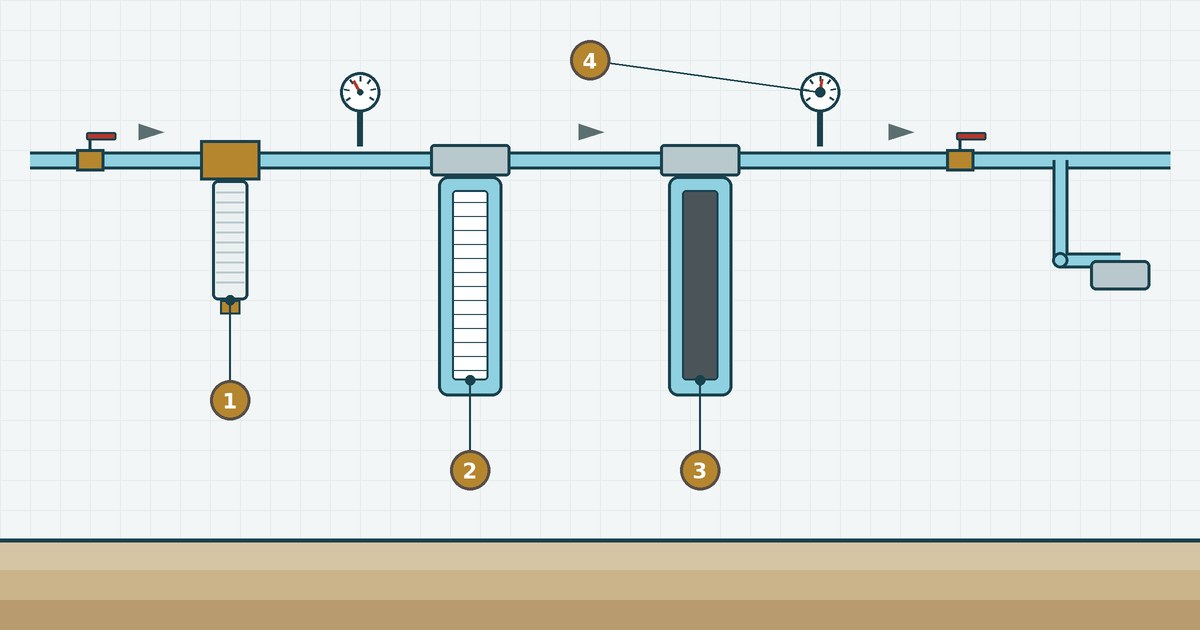
A whole-house filter treats all the water entering the house, protecting pipes, taps, the water heater and the washing machine, not just the kettle. The most common mistake is fitting one “universal” cartridge and expecting miracles. Only a multi-stage setup works, with each stage removing its own kind of contaminant.
What the diagram shows
1 — a strainer at the inlet, 2 — sediment filtration (20 µm cartridge), 3 — a carbon cartridge, 4 — pressure gauges before and after the filters.
Stages in order
- A 100–300 µm strainer right after the inlet valve or pump. It catches sand and scale; the mesh is rinsed, not replaced. Without it the next cartridges clog within a week.
- 20–50 µm sediment — a foamed polypropylene or string-wound cartridge that removes fine particles and rust that got past the mesh.
- A special stage based on a water test. For mains water, carbon against chlorine and odour. For a borehole, iron removal if the water turns yellow and leaves rusty stains. For hard water, scale protection or a softener.
- For drinking water add an under-sink reverse osmosis unit — a whole-house filter does not replace it.
Do not choose a filter by eye. Test the water at least for iron, hardness and turbidity — how to read the results is explained in “Choosing a water filter by water test”.
Which housing size
- Standard 10" — for a flat or summer house with one or two taps in use.
- Big Blue 10" and 20" — for a private house: the cartridge is thicker, passes more water and needs replacing less often. Connection is 1".
- Duplex and triplex housings on one bracket save space and installation time.
Installation: three rules
- Gauges before and after the filters show when a cartridge is clogged: once the pressure difference has grown noticeably (usually 0.5–1 bar), it is time to replace it.
- A three-valve bypass lets you change cartridges without leaving the house without water.
- Cold water housings are not used on hot water — there are separate heat-resistant ones for that.
Everything for this setup is collected in our selections: Y-strainers, Big Blue housings, Big Blue cartridges, sediment cartridges and duplex and triplex housings. How to change a cartridge without a flood — see “Replacing a cartridge”; how to flush the mesh — here.