
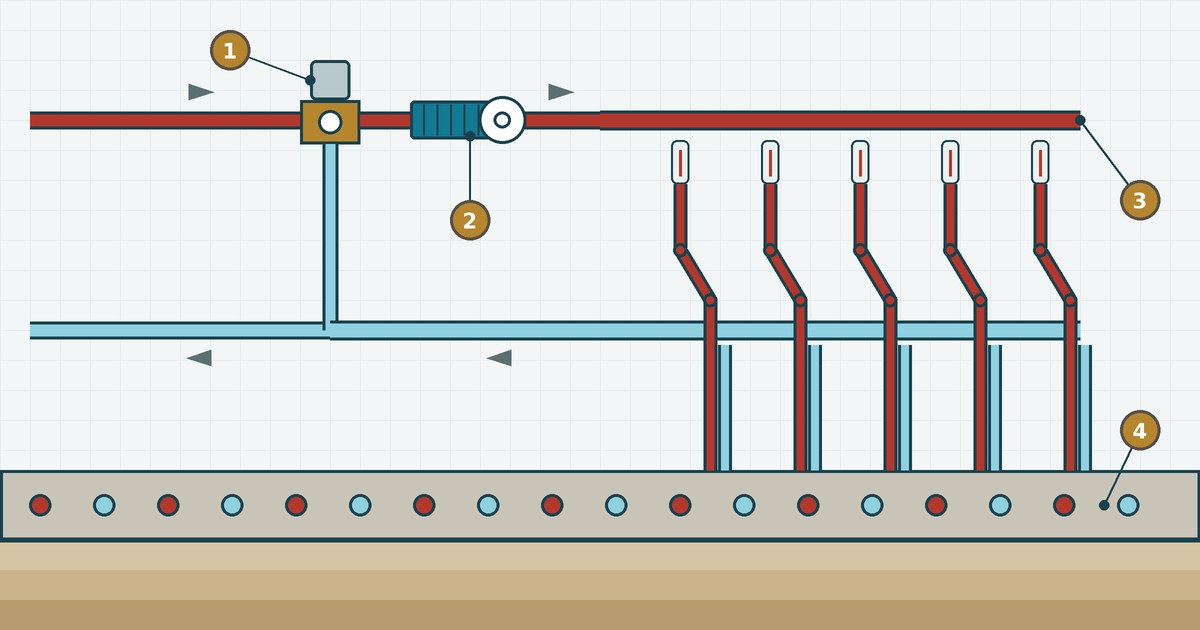
A boiler heats water to 60–80 °C, while floor pipes need 35–45 °C: any hotter and it is unpleasant to walk barefoot and the screed cracks. That is why underfloor heating is never connected straight to the boiler — a mixing unit and a manifold go in between. Here is what each part does.
What the diagram shows
1 — a three-way mixing valve, 2 — the floor circuit circulation pump, 3 — a manifold with flow meters, 4 — underfloor pipes in the screed.
System components
- The mixing valve (1) blends hot water from the boiler with cooled return water and holds the set temperature. It can be thermostatic (with a knob and scale) or driven by an actuator under a controller.
- The pump (2) circulates water through the floor loops. A dedicated pump is needed because long loops have far more resistance than radiators.
- The manifold (3) distributes water to the loops. Flow meters on the flow bar show the flow in each loop and let you balance them; return valves can take actuators so each room keeps its own temperature.
- Pipes (4) — 16 mm PEX-a or multilayer pipe laid as continuous loops with no joints in the screed.
Installation step by step
- Level the base, lay insulation (usually 3–5 cm over a floor slab, more on ground) and edge strip along the walls.
- Fix the manifold in its cabinet and lay out loops to plan — one per room or per 10–15 m², with the flow running along cold walls and windows.
- Connect the loops to the manifold and label which goes where.
- Pressure test at 1.5 times the working pressure, usually about 6 bar, for 24 hours. The screed is poured while the pipes are under pressure.
- Pour the screed (at least 3 cm above the pipe). Let a cement screed cure for about 28 days before switching the floor on, raising the temperature gradually.
- Balance the loops with the flow meters and set the temperature on the mixing valve.
How many loops you need and how long they can be is worked out in “How many underfloor heating loops you need”. For the mixing unit see three-way valves, manifolds with flow meters or actuator-ready manifolds, PEX-a pipes and manifold cabinets. The pump is sized the same way as for radiators — see “How to choose a circulation pump”.