
A trickling shower, a gas water heater that will not ignite, a washing machine that takes half an hour to fill — familiar to people on upper floors and in dacha villages. A booster pump adds pressure right at the inlet of the flat or house. It does not always help, though, and choosing the right type matters.
What the diagram shows
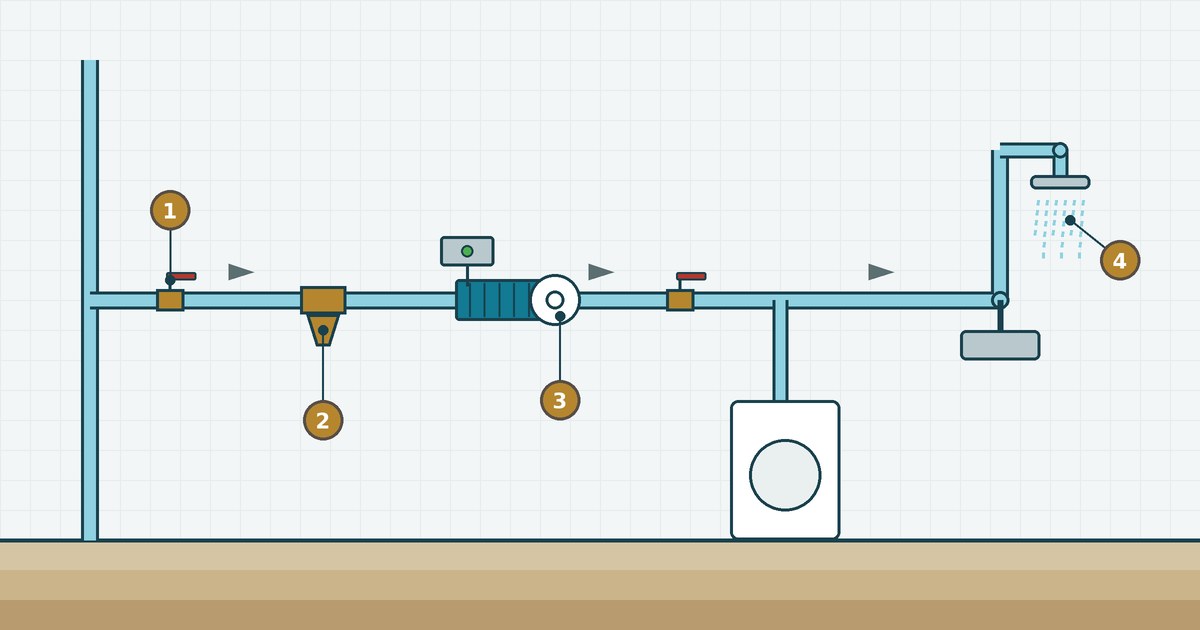
1 — water inlet with a ball valve, 2 — a strainer, 3 — a booster pump with a flow switch, 4 — a mixer tap and shower (a washing machine next to it).
First find the cause
A pump can only raise pressure if there is water in the pipe. Open the inlet valve: if pressure is weak everywhere and all the time, the mains is the problem and a pump will help. If only hot water or a single tap is weak, look for a blockage, a clogged aerator or filter — see “Low water pressure”. If water disappears completely in the mornings, you need a storage tank and a booster set.
Types of pump
- Inline pump with a flow switch — small, fitted straight into a 1/2"–3/4" pipe. It starts by itself when a tap is opened and adds roughly 1–1.5 bar. Quiet; suits a flat, a water heater or a gas geyser.
- Booster set with a tank — more powerful, holds pressure via a pressure switch and can draw from a tank when the mains is dry. Needed when the whole house lacks pressure or supply is intermittent.
Installation step by step
- Turn the water off. The pump goes after the meter: valve → strainer → pump → valve.
- The strainer is a must: sand and scale quickly jam the impeller and the flow switch.
- Fit the pump following the arrow on the body. Wet-rotor pumps need a horizontal shaft — check the manual.
- Plug it into an earthed socket; the spot should be dry and accessible for servicing.
- Open the water, bleed the air and choose the mode: “auto” starts on flow, “manual” runs constantly (for testing only).
Inline pumps are in pressure booster pumps, booster sets in booster sets with a 24 L tank, and strainers in Y-strainers. How to connect a booster set — see “Booster set for a private house”.