
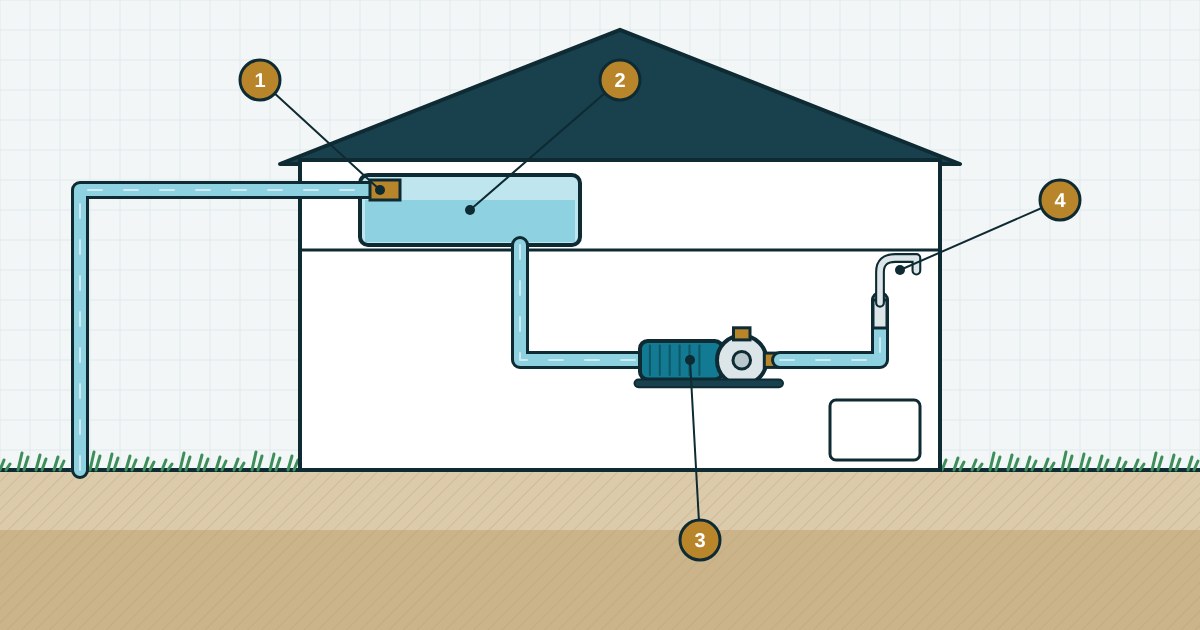
A storage tank helps when water is scarce or not always available: a low-yield borehole, an unreliable mains supply, water delivered on a schedule. The tank fills slowly, and the house draws water from the reserve at normal pressure.
What the diagram shows
1 — the float valve on the tank inlet, 2 — the tank itself, 3 — the pump that supplies the house from the tank, 4 — the taps.
How big a tank
Allow 150–200 L per person per day. A 600–1000 L tank is enough for a family of four for a whole day without any supply. With a weak borehole, size the tank so that it refills overnight.
Layout and parts
- Tank — food-grade, opaque plastic with a lid: water exposed to light grows algae.
- Float valve on the inlet stops the water when the tank is full. Above 5 bar supply pressure, choose a diaphragm valve.
- Overflow — a pipe 3–5 cm above the working level, routed to the drain or outside.
- Outlet — 5–10 cm above the bottom, where sediment settles.
- Booster set or a surface pump with a pressure tank to pressurise the house.
- Drain valve at the bottom to flush the tank once a year.
Installation steps
- Place the tank on a level base in a warm spot — a basement, boiler room or insulated loft.
- Make the connections: inlet with the float valve at the top, overflow, outlet near the bottom, drain.
- Connect the booster set to the outlet through a coarse filter.
- Fill the tank, set the level with the float and check that the overflow works.
Put a heavy tank in the loft only if the floor can carry it: 1000 L of water weighs a tonne.
Everything for this layout is in our float valves and pressure tanks sections.