
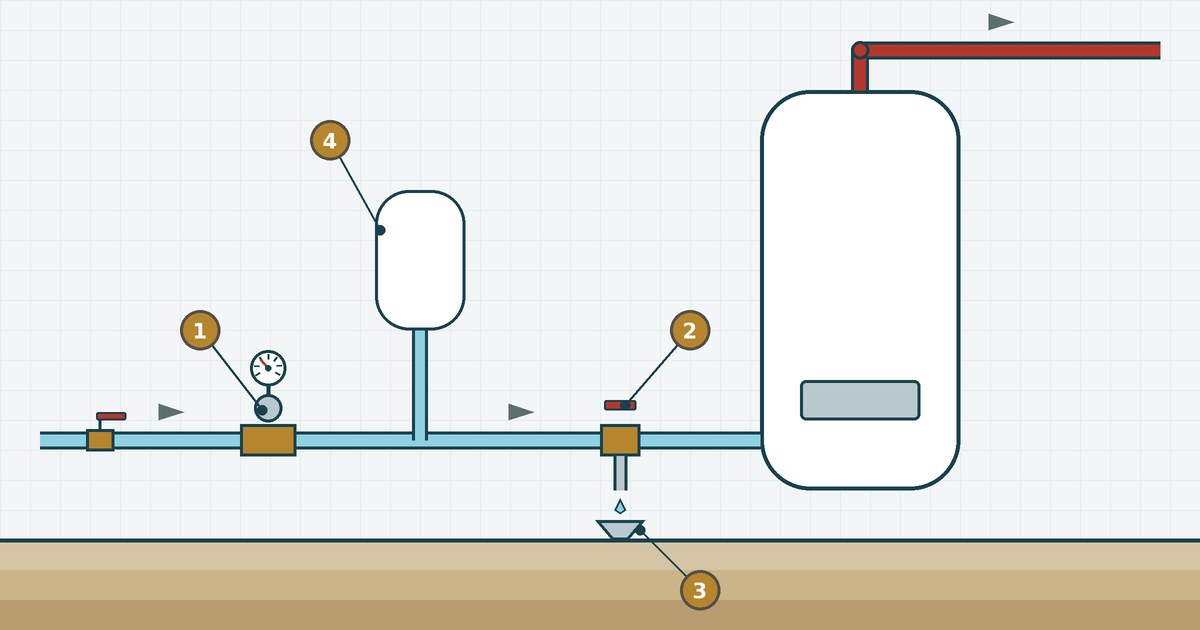
The valve on the cold inlet of the water heater drips — some people put a jar under it, others want to plug it. The first is a nuisance, the second is dangerous. First work out whether the valve is simply doing its job or pointing to a problem you can fix.
What the diagram shows
1 — a pressure reducing valve on the cold supply, 2 — the water heater safety valve, 3 — the valve discharge to the drain through a tundish, 4 — an expansion vessel for hot water.
When dripping is normal
Water expands as it heats: an 80-litre heater warming from 10 to 70 °C gains about 2 litres. While no hot water is drawn off, that volume has nowhere to go, so the valve releases it — a few drops during heating. That is the valve working, not failing.
When it is a problem
- It runs constantly, even when the heater is not heating — mains pressure is above the valve setting (usually 6–8 bar), or scale and sand keep the valve from closing.
- It dumps a lot of water every heating cycle — high inlet pressure; mains pressure often rises at night.
- It never drips — the valve may have seized. This is the most dangerous case.
What to do
- Measure the inlet pressure with a gauge, ideally at night. Above 4–5 bar you need a pressure reducing valve (1) in front of the heater, set to 3–4 bar.
- Fit a hot water expansion vessel (4) — white or blue, rated for potable water, about 10 % of the heater volume. It takes up the expanded water and the valve stops dripping during heating.
- Test the valve itself: once a month lift the lever for a couple of seconds — water should flow and stop when released. If it keeps running or the lever is stuck, replace the valve; it is inexpensive.
- Pipe the discharge (3) to the drain through a tundish with an air gap — the water goes away without smells.
6–10 bar valves are in water heater safety valves, reducers in pressure reducing valves. The full layout is in “How to connect a water heater”; setting a reducer — here.