
A tapered or parallel pipe thread is not watertight on its own: there are gaps between the turns. A sealant fills them. A well-chosen and properly wound sealant lasts for decades; the wrong one starts dripping within a month.
What the diagram shows
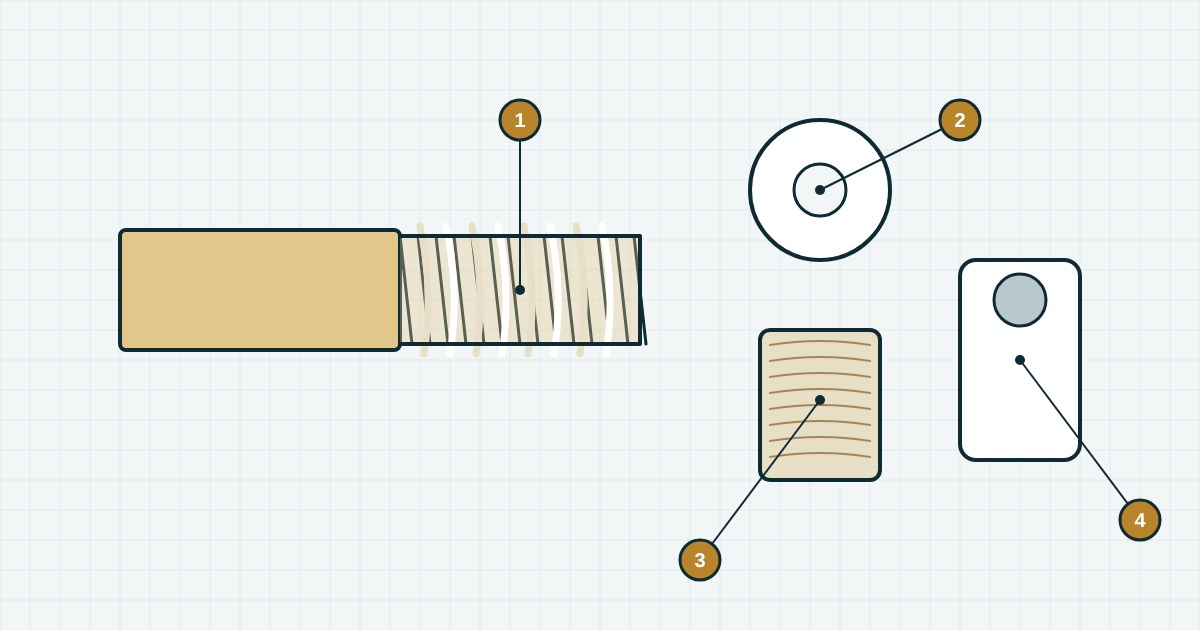
1 — a thread with sealant wound on, 2 — PTFE tape, 3 — plumbing hemp, 4 — thread sealing cord.
Comparison
- Hemp with paste — the classic for metal and heating. It swells with water and seals itself, and lets you back the fitting off by 10–15° without leaks. Without paste hemp rots, so the paste is a must.
- PTFE tape — quick and clean, good for cold water and accurate, fine threads. It does not tolerate backing off: if you unscrew, re-wrap.
- Thread sealing cord — convenient, pressure-ready at once and allows a small position adjustment. Good on both plastic and metal threads.
- Anaerobic sealant — for accurate, clean threads with no play; the joint is hard to undo later.
How to wind it
- Clean the thread of old sealant and dirt. On a smooth new thread make light nicks with a hacksaw — hemp will grip better.
- Wind in the direction of the thread — clockwise when looking at the pipe end. Otherwise the winding slips off as you screw the fitting on.
- Start from the second turn from the end so that fibres do not get into the pipe.
- Hemp: a thin, even strand with paste on top. PTFE tape: 10–15 turns under tension. Cord: 5–10 turns crossing over.
- Screw the fitting on by hand, then 1–2 turns with a spanner. Do not overtighten: a brass fitting can crack.
Do not put a lot of hemp on a plastic thread: as it swells it can split a plastic socket.
For pumps and tanks — brass fittings, valves and accessories.