
You can connect a washing machine in an hour if you plan three things in advance: a dedicated water valve, a correct drain and a level installation. Most leaks, and machines that “drain by themselves”, come down to mistakes in exactly these places.
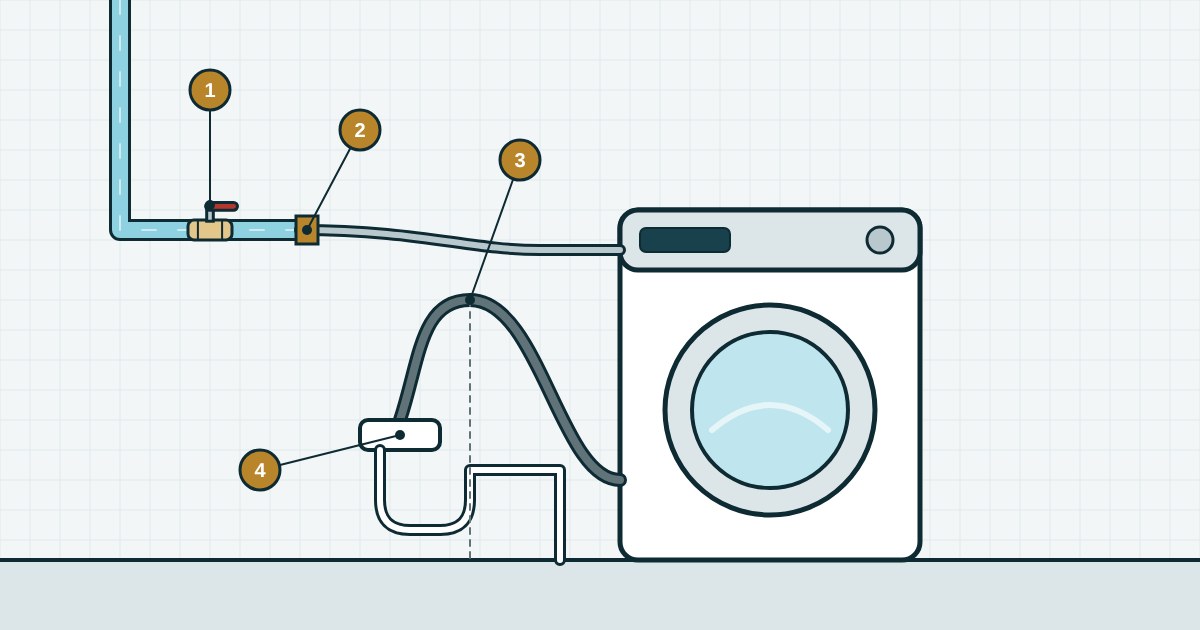
What the diagram shows
1 — a dedicated valve for the machine, 2 — the 3/4" union nut of the fill hose, 3 — the drain hose raised into a loop, 4 — the drain connected to the trap.
What you need
- an appliance valve 1/2"×3/4" or a tee with a valve, if the machine is connected to an existing pipe;
- a fill hose of the right length (usually supplied with the machine);
- a sink trap with a washing machine spigot, or a separate trap for the machine;
- PTFE tape or hemp with paste — for the valve thread only, not for the hose nut.
Connecting the water
- Shut off the water and release the pressure by opening the nearest tap.
- Fit the machine valve: on plastic pipe with a threaded tee, on metal pipe into an existing outlet or through an adapter. A dedicated valve lets you shut the water off when the machine is not running.
- Screw on the fill hose nut by hand, without hemp or tape: the rubber washer inside the nut does the sealing. A spanner may add a quarter turn, no more.
- Check the strainer at the machine inlet. If your water carries a lot of sand, fit a mesh filter before the valve — the machine’s own strainer clogs quickly.
Connecting the drain
- The loop. The drain hose must rise to the height stated in the manual (usually 60–90 cm above the floor) before it goes into the drain. If the hose lies lower than the drum, water will siphon out during the wash.
- The trap. Connect the drain to a trap with a non-return valve or above the water seal, so sewer smells cannot get into the machine.
- No tension. The hose must not be kinked or stretched: the machine vibrates during spin and will eventually pull it out of the trap.
Installation and first run
- Remove the transit bolts at the back — without this the machine will damage itself on its first spin.
- Level the machine with the adjustable feet and lock them with their nuts.
- Open the valve and check the joints with a dry tissue. Run a short wash without laundry and watch the drain and the floor under the machine.
The machine’s solenoid valve closes sharply and causes a small water hammer. If the pipes start banging after installation, fit a water hammer arrestor next to the machine valve — see “Water hammer in household plumbing”.
The socket for a washing machine must be earthed and protected by an RCD. If the bathroom has no such socket, have an electrician install it.
Appliance valves are in valves and fittings; mesh filters are in water filters.