
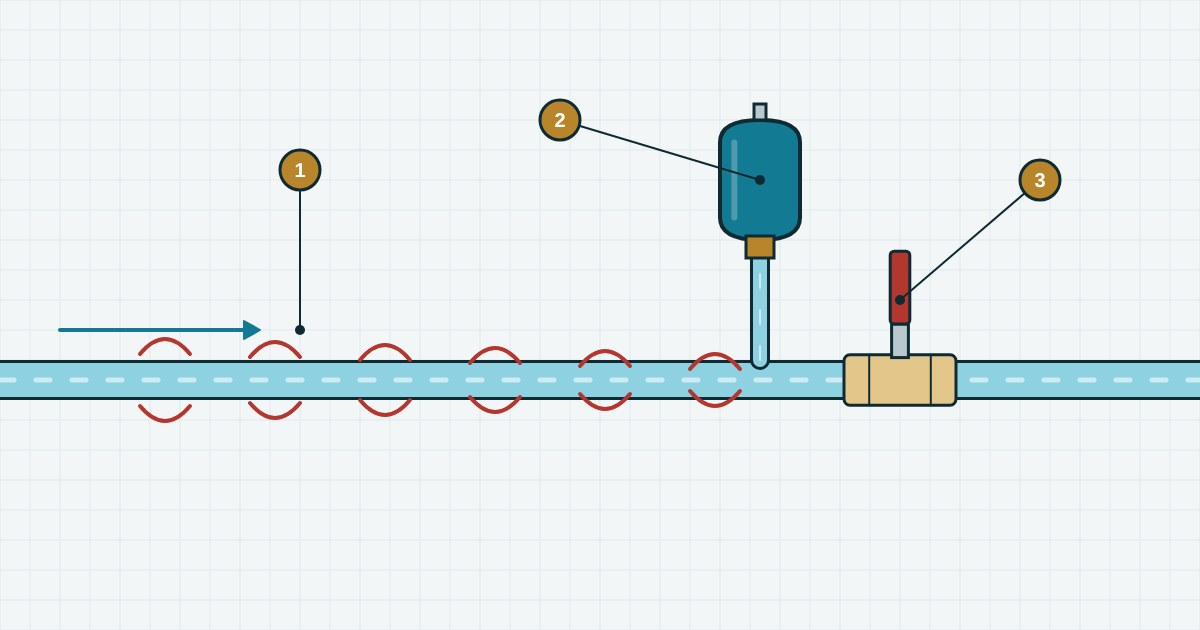
Water hammer is a sudden pressure spike that happens when the flow in a pipe stops abruptly. Water is heavy, and its whole mass slams into the closed valve. For a fraction of a second the pressure can be several times higher than normal. You hear it as a bang or knock in the pipes.
What the diagram shows
1 — the pressure wave travelling along the pipe, 2 — a water hammer arrestor (a small diaphragm tank), 3 — a valve that was closed quickly.
Where it comes from
- Ball valves and single-lever mixers that are shut quickly.
- Solenoid valves in washing machines and dishwashers — they close instantly.
- A powerful pump stopping without a check valve or with a faulty one.
- Air in the pipes and excessive mains pressure.
Why it is dangerous
Every bang stresses joints, flexible hoses, mixer cartridges and diaphragms. Sooner or later this ends in a leak — most often a flexible hose under the sink or behind the washing machine bursts.
How to protect the system
- A water hammer arrestor — a small tank with a diaphragm and 0.16–0.5 L of air. The air absorbs the shock like a spring. Fit it close to the source: on the branch to the washing machine or dishwasher, next to a fast-closing valve.
- A pressure reducing valve at the inlet keeps 3–4 bar in the house instead of 6–8 bar in the mains.
- A pressure tank in a pump system acts as an arrestor for the whole house.
- A habit of closing taps smoothly.
Mount the arrestor upright, air chamber on top, as close as possible to the valve that causes the shock.
Compact water hammer tanks are in our pressure tanks section.