
The weakest points of a water supply in winter are the stretch of pipe next to the house, the entry through the foundation and the borehole head. The ground freezes deepest there and snow is often blown away. There are three ways to protect the pipe, and they are usually combined.
What the diagram shows
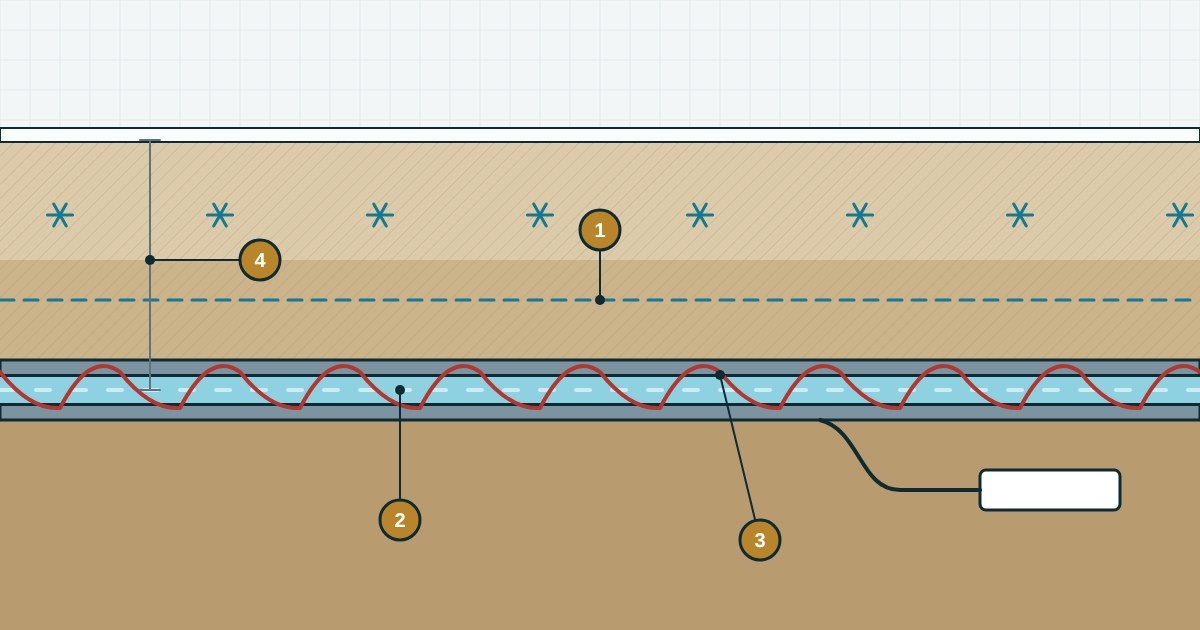
1 — the frost line, 2 — the insulated pipe, 3 — the heating cable, 4 — the burial depth.
1. Depth
The most reliable method is to bury the pipe below the frost line. In most regions of Ukraine that is 0.8–1.2 m; local builders or the building code for your region will give the exact figure. Add 20–30 cm of margin. Under paths and areas cleared of snow the ground freezes deeper.
2. Insulation
If you cannot dig deep (rock, high groundwater), lay the pipe shallower but insulated: polyurethane foam shells or foamed polyethylene at least 30–50 mm thick. Extruded polystyrene boards laid over the trench keep the frost from going down.
3. Heating cable
A self-regulating cable rated at 10–20 W per metre increases its output in the cold and reduces it when it is warm. It is laid along the pipe under the insulation or run inside the pipe through a special gland. Switch it on during frosts or fit a thermostat.
Weak spots
- House entry — run the pipe through a sleeve in the foundation, foam the gap and insulate the section under the apron especially well.
- Well head and chamber — cover with an insulated lid, backfill with soil or install an insulated well chamber.
- A drain valve by the borehole lets you empty the pipe if you leave for a long time.
Pumps, tanks and controls for a borehole system are in our pumps and pump controls sections.