
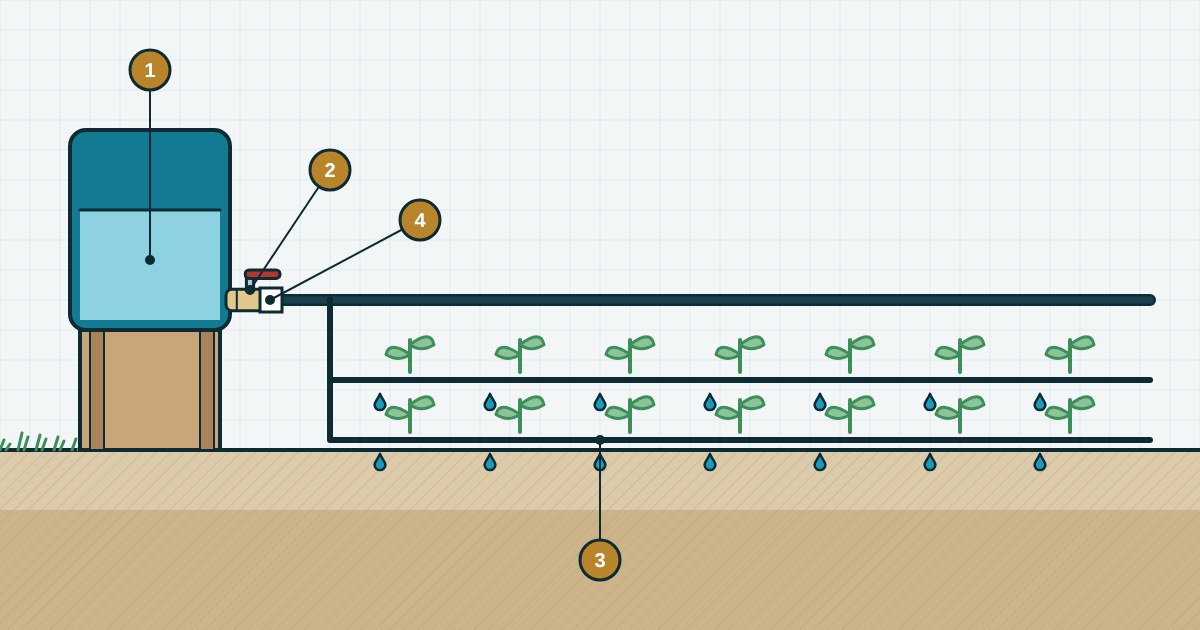
Drip irrigation delivers water straight to the roots, uses up to half as much water as a hose and keeps the leaves dry. For a small vegetable garden you can build it without a pump at all — the water flows by gravity from a tank on a stand.
What the diagram shows
1 — the tank on a stand, 2 — the valve and filter, 3 — drip lines along the beds, 4 — the main pipe.
What you need
- A 200–1000 L tank or barrel, opaque, with a lid.
- A stand 1–2 m high. Each metre of height gives only 0.1 bar, so use drip tape and emitters designed for low pressure.
- A ball valve and a screen or disc filter — emitters clog very easily.
- 16–25 mm HDPE main pipe, take-off connectors, drip tape, end plugs.
- A float valve if the tank is filled from the mains or a borehole.
Installation
- Place the tank on a stable stand at the highest point of the plot.
- Make the outlet 5–10 cm above the bottom so sediment stays in the tank. Fit the valve and the filter.
- Lay the main pipe across the beds. Where each bed starts, punch the pipe and insert a take-off connector.
- Connect the drip tape to the connectors with the holes facing up. With gravity feed, keep each line within 15–20 m, otherwise little water reaches the end.
- Plug the ends of the tapes and the main pipe.
- If the tank refills automatically, fit a float valve at the top — it shuts off the water when the tank is full.
Watering for 30–60 minutes in the morning or evening is usually enough. For full automation, fit a battery-powered irrigation timer on the tank outlet.
Maintenance
Rinse the filter once a week. At the end of the season open the end plugs and flush the tapes, then drain the tank and pipes so frost does not split them.
To fill the tank, use our float valves and matching floats.