
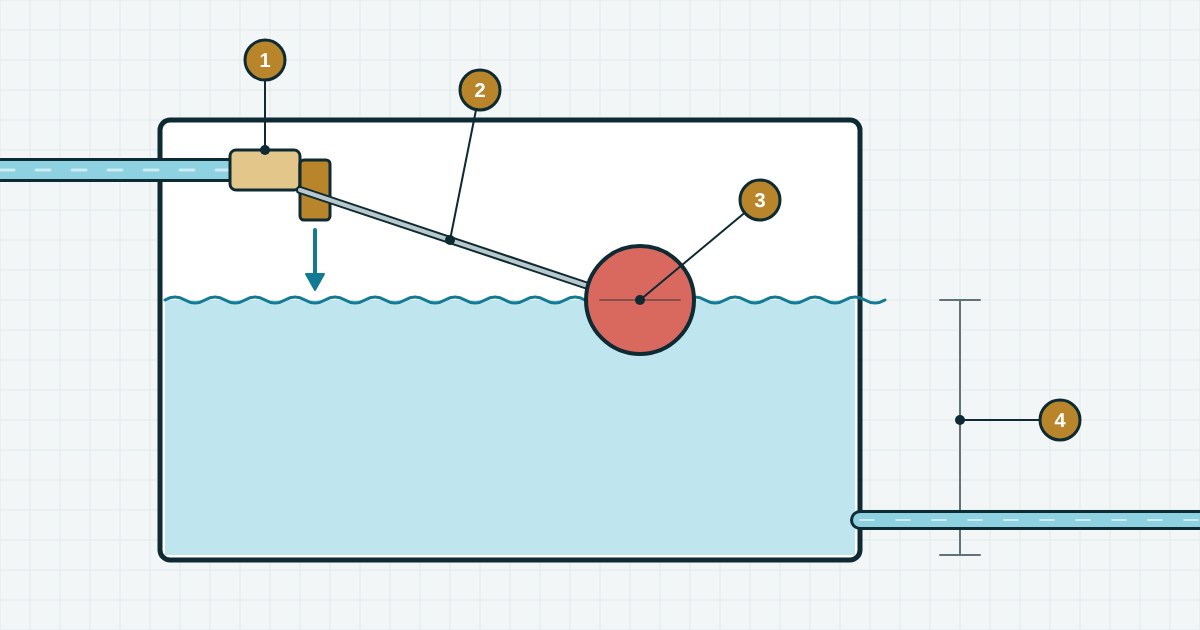
A float valve fills a tank and shuts off the water by itself when the tank is full. It is used in storage tanks, irrigation containers, livestock drinkers, pools and cisterns. It needs no electricity: the float rising with the water does all the work.
What the diagram shows
1 — the valve body on the inlet pipe, 2 — the lever, 3 — the float, 4 — the working water level set by the length and angle of the lever.
Types
- Lever (piston) valves are simple and reliable and suit pressures up to 5–6 bar. Larger sizes need a bigger float.
- Diaphragm valves close smoothly without knocking and handle higher pressure. Good for high-pressure mains.
- Valves with pressure regulation work at up to 12 bar and can be fitted directly to the mains.
How to choose
- Size — match the inlet pipe: 1/2" for barrels and tanks up to 500 L, 3/4"–1" for containers of a cubic metre and more.
- Pressure — check the supply pressure. Above 5 bar, choose a diaphragm valve or one with pressure regulation.
- Float — a large valve needs a larger float, otherwise it will not have the force to shut off the flow. Copper and stainless floats outlast plastic ones; for hot water use metal only.
Installation
- Drill a hole in the tank wall 5–10 cm below the top edge, above the planned water level.
- Insert the valve and tighten the nuts with washers on both sides of the wall.
- Screw on the lever and the float and connect the supply.
- Turn the water on and see where the valve closes. To raise the level, bend the lever up or move the float; to lower it, do the opposite.
- Always fit an overflow pipe just above the working level in case the valve fails to close.
If the valve knocks when it closes, fit a pressure-regulating valve in front of it or replace the lever valve with a diaphragm one.
Pick a valve and a matching float in our float valves and floats sections.