
You should not be able to hear your pipes. If the plumbing hums, whistles or bangs, it is almost always a warning that something is wearing out faster than it should. The kind of sound tells you where to look, no plumber needed.
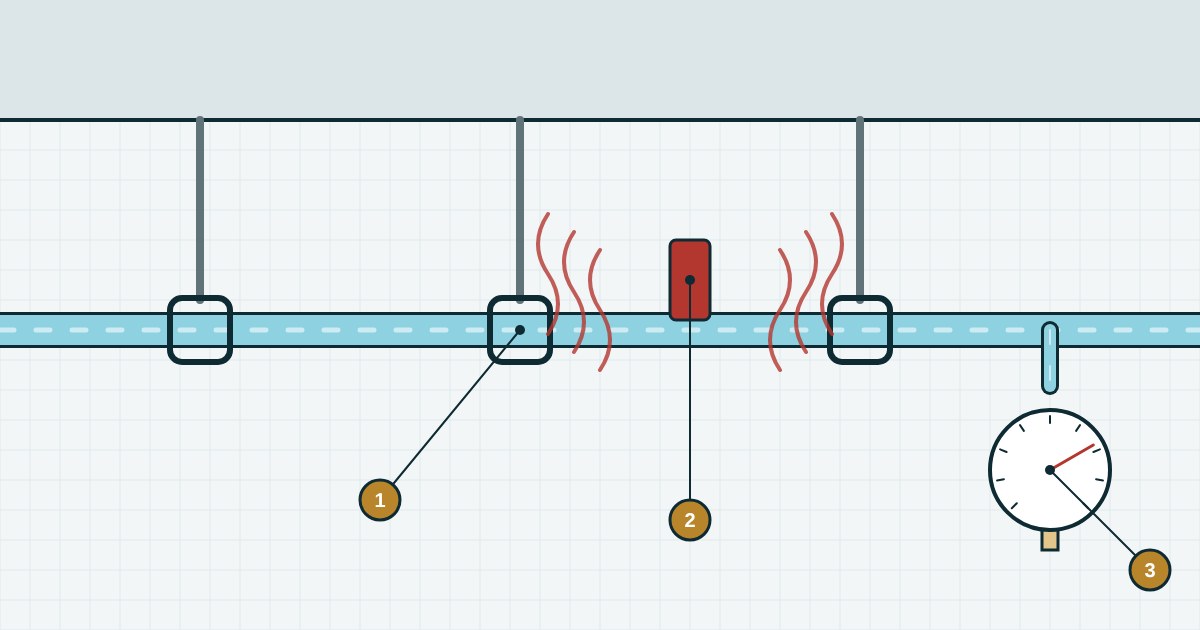
What the diagram shows
1 — a loose pipe clamp, 2 — a tap with a worn washer or cartridge, 3 — a pressure gauge to check the system pressure.
A hum when a tap is open
- A worn washer or tap cartridge. The rubber washer starts to vibrate in the flow. Shut off the water and replace the washer or the whole cartridge.
- Pressure that is too high. A house does not need more than 4–5 bar. Fit a pressure reducing valve at the inlet or lower the pump’s pressure switch setting.
- A pipe that is too narrow. Water speeds up in a thin pipe and gets noisy. Only a larger pipe helps.
Bangs and knocks when a tap closes
This is water hammer: the flow stops abruptly. The cure is a water hammer arrestor next to fast-closing taps and appliance valves, plus a pressure tank in a pump system.
Rattling and vibration
Pipes knock against walls or each other. Tighten the clamps, put rubber inserts under them and add brackets on long runs: every 50–100 cm for plastic pipes.
Clicking on hot water
Pipes lengthen when heated and rub in their brackets. Long runs need expansion loops and sliding supports, and plastic hot-water pipes must be reinforced.
Gurgling and bubbling
There is air in the system. Open the highest taps and let the water run until it stops spluttering. If the air keeps coming back, look for an air leak on the pump suction side.
Water hammer arrestors and tanks are in the pressure tanks section, pressure switches in pump controls.