
A pump that starts every 10–20 seconds wears out many times faster: the motor heats up on every start and the switch contacts burn. You can almost always find the cause yourself. Check in order, from the simplest to the hardest.
What the diagram shows
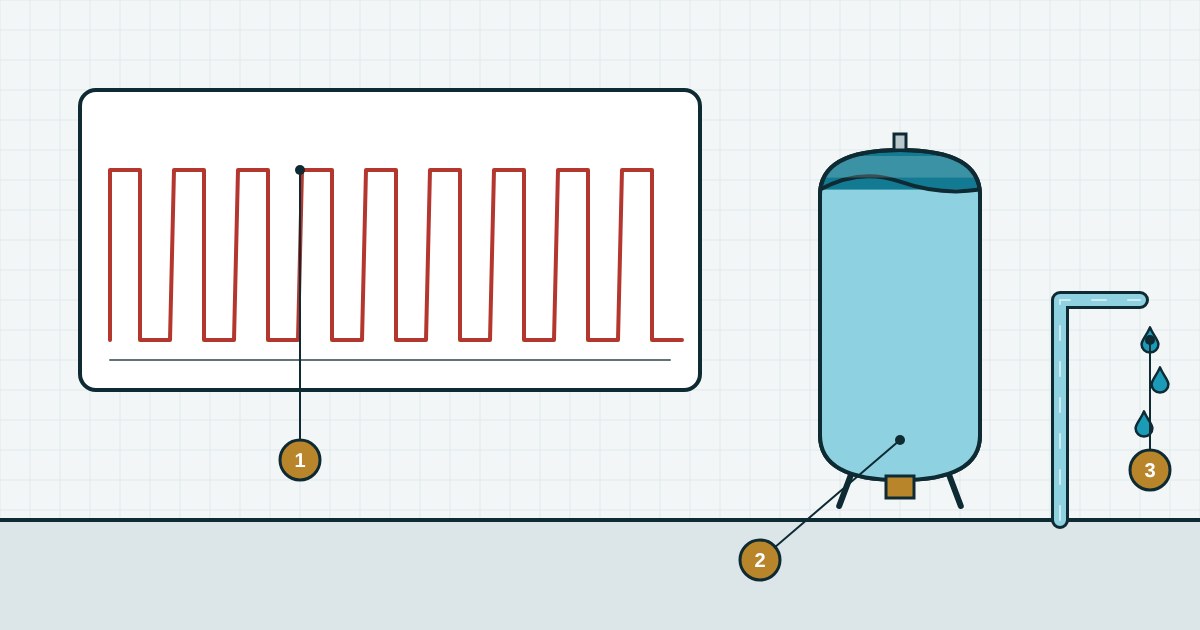
1 — frequent short pump cycles, 2 — a pressure tank with almost no air left, 3 — a leak that makes the pressure drop even with all taps closed.
1. Not enough air in the pressure tank
The most common cause. Drain the water and check the pressure at the air valve: it should be 0.2–0.3 bar below the pump cut-in pressure. Details are in our article on checking the air in a pressure tank.
2. A torn diaphragm
If water sprays from the air valve, the diaphragm is torn and the tank works like an ordinary pipe. Replace the diaphragm, or the whole tank if the diaphragm is fixed.
3. The tank is too small
An 8–18 L tank for a borehole pump is almost always too small. A 1 kW pump needs a tank of 50 L or more. You do not have to remove the old tank — add a second one in parallel.
4. Too small a pressure difference on the switch
If the switch starts the pump at 2.0 bar and stops it at 2.4 bar, the cycles will be short. A normal difference is 1–1.5 bar.
5. A leak or a faulty check valve
Close all taps and watch the gauge. If the pressure drops and the pump starts by itself, something is leaking: a toilet cistern, a tap, a joint. If there are no leaks, water is flowing back into the borehole through a faulty check valve.
6. A clogged switch or filter
Sand in the switch inlet distorts its readings. A clogged filter on the pump outlet causes sharp pressure jumps. Clean both.
Replacement tanks, switches and valves are in the pressure tanks and pump controls sections.